When choosing between smart vending machines and traditional vending machines, the decision boils down to cost, management style, and user expectations. Here’s a quick breakdown:
- Traditional vending machines: Simple, offline systems that rely on manual restocking and cash payments. Best for low-traffic areas with less than 75 daily users or locations without reliable internet. Cost: $3,000–$6,500 upfront.
- Smart vending machines: Connected devices with real-time monitoring, cashless payments, and predictive maintenance. Ideal for high-traffic areas (100+ daily users), offering better user experience and efficiency. Cost: $4,000–$20,000 upfront, with monthly fees of $50–$200.
Key stats:
- Smart machines generate 2–3x the revenue of traditional ones.
- 71% of U.S. vending sales are now cashless, with 77% of those using contactless payments.
- Smart systems reduce restocking labor costs by up to 60% and downtime by 70%.
Quick Comparison:
| Feature | Traditional Vending | Smart Vending |
|---|---|---|
| Management | Manual, on-site | Remote, real-time |
| Payment Options | Cash/coins | Cashless (NFC, QR, etc.) |
| Inventory Tracking | Manual counts | Automated, cloud-based |
| Avg. Transaction Value | $1.50–$3.50 | $4.00–$15.00 |
| Setup Cost | $3,000–$6,500 | $4,000–$20,000 |
Bottom line: Smart vending machines are better for facilities aiming to maximize revenue and efficiency, while traditional machines work for smaller, low-traffic locations. Conduct a one-week traffic audit to determine the best fit for your needs.
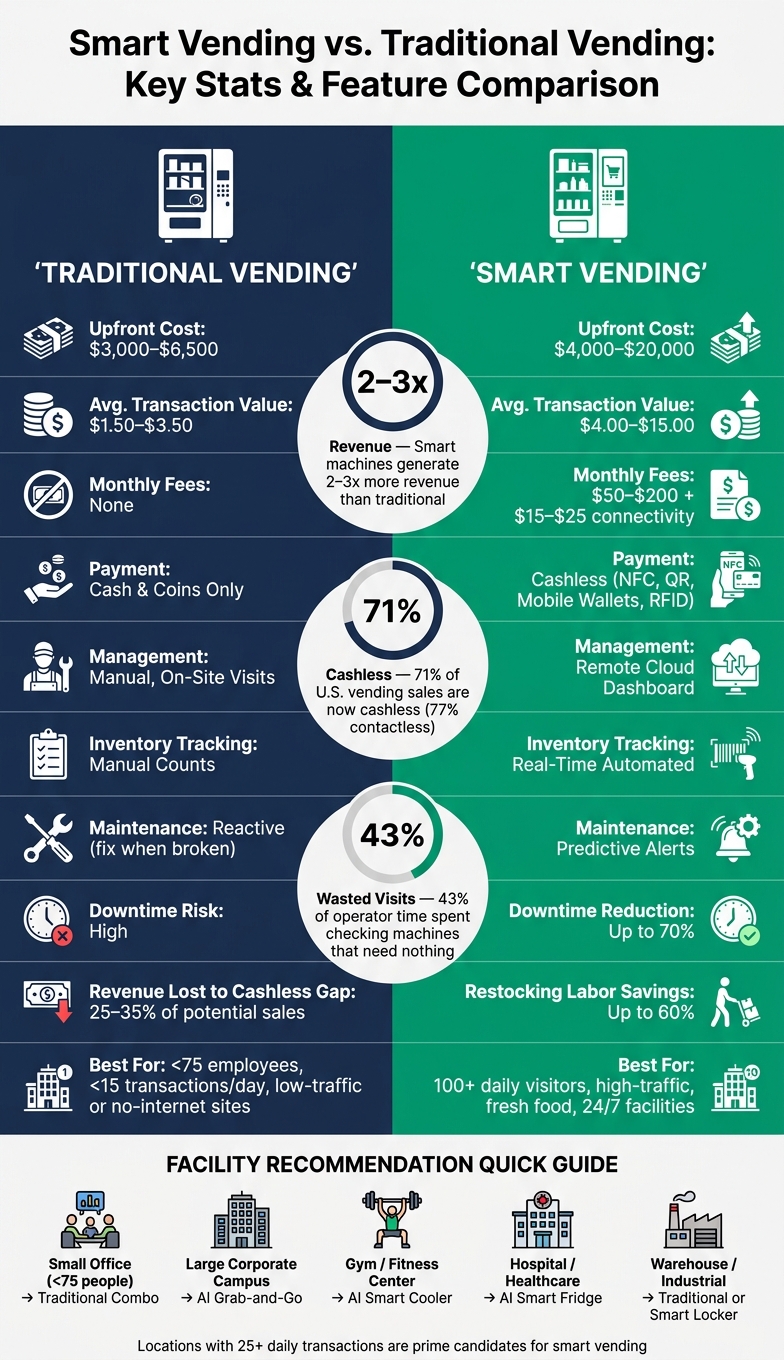
Smart Vending vs. Traditional Vending: Key Stats & Feature Comparison
Traditional Vending Machines: How They Work and Where They Fall Short
How Traditional Vending Machines Work
Traditional vending machines operate through fairly straightforward mechanics. Inside the machine, products are arranged on spiral coil trays. When a user selects an item, the control board triggers a motor, rotating the coil and releasing the product into the retrieval bin. Gravity does the rest, delivering the item to the customer.
Payments are handled through a coin mechanism, which uses magnetic and size sensors to validate coins, or a bill acceptor that scans paper currency. Users interact with the machine via a physical keypad or alpha-numeric buttons. These machines are entirely offline – there’s no Wi-Fi, no cloud connection, and no way to remotely monitor them. While simple, this design comes with several operational challenges.
Common Problems with Traditional Vending
One of the biggest issues is the lack of real-time monitoring. Operators have no way of knowing if something goes wrong without physically visiting the machine. For instance, if a bill acceptor jams on a Wednesday and no one checks the machine until Friday, it could mean two full days of lost sales.
Stockouts are another frequent problem. Popular items may sell out quickly after restocking, leaving the machine empty until the next service visit. Additionally, older machines can’t confirm whether a product was successfully dispensed.
"The machine assumes the product dropped. It has no way to verify. If the item gets stuck on the coil, the customer loses money, and the operator never knows until someone complains." – Agape Vending Machines [5]
Handling cash manually adds another layer of difficulty. Collecting, counting, and depositing coins and bills eats up time and increases the risk of theft. Plus, cash-only machines miss out on a huge chunk of potential sales. In fact, it’s estimated that such machines lose between 25% and 35% of potential revenue because over 60% of vending transactions in urban areas are now cashless as of 2026 [5][6].
These limitations make it clear why traditional machines aren’t ideal for every environment. They highlight the need for smarter alternatives, which are discussed later in this article.
Where Traditional Vending Machines Are Typically Used
Traditional vending machines are most effective in low-traffic locations. Think small auto repair shops, laundromats, or office breakrooms with fewer than 75 employees [2][5]. In these settings, the low volume of transactions – fewer than 15 per day – doesn’t justify the expense of upgrading to smarter technology [5][6].
They’re also a practical choice for industrial sites where internet access is spotty or nonexistent. In such cases, a basic snack or combo machine can get the job done, provided there’s someone available to service it regularly.
Smart Vending Machines: Key Features and Facility Benefits
Smart vending machines bring a modern twist to traditional vending by delivering real-time data to operators, eliminating guesswork. These machines connect to the cloud via 4G/5G or Wi-Fi, continuously feeding information – like sales, stock levels, temperature, and machine health – to a central dashboard accessible from any smartphone or computer. This connectivity unlocks advanced management capabilities that streamline operations.
AI and IoT-Driven Management
Gone are the days of routine visits to vending machines. Operators can now monitor stock levels, detect early signs of component wear, and ensure internal temperatures remain safe – all in real time. This allows for dynamic dispatching, where service routes are built based on immediate needs rather than fixed schedules. The result? Restocking labor costs can drop by as much as 60% compared to traditional methods [5].
Predictive maintenance is another game-changer. By continuously tracking machine components, operators are alerted to potential issues before they lead to breakdowns, cutting machine downtime by up to 70% [5].
"A smart vending machine isn’t automatically ‘AI.’ Most of the value comes from IoT connectivity – the machine’s ability to send data to a system you can read and act on." – VendSoft [9]
Better User Experience
Modern vending machines enhance the user experience with HD touchscreens that replace outdated keypads. These screens let users browse by category, check nutritional details, and make multi-item purchases in one transaction. Payment options are equally advanced, including contactless methods like credit cards, Apple Pay, Google Pay, QR codes, and even employee RFID badges. This is crucial as 71% of U.S. vending users now prefer cashless payment, with 77% of those opting for tap-to-pay [7]. Additionally, smart machines see 26% to 37% higher average transaction values compared to cash payments [7].
Some machines take convenience even further with grab-and-go technology, where customers simply take an item, and the machine processes the charge automatically. AI-powered computer vision ensures over 99% accuracy in identifying items [4][8]. For standard smart machines, integrated sensors detect dispense issues and can trigger automatic refunds, eliminating the frustration of stuck items that often plague traditional units.
Energy Efficiency and Sustainability
Energy efficiency is a key focus for smart vending machines. Most models use LED lighting instead of fluorescent bulbs and feature motion sensors that shift the machine into a low-power state during quiet times, "waking up" only when a customer approaches [10][4]. Remote temperature monitoring also ensures that cooling issues are flagged before they lead to spoiled products or emergency repairs.
Real-time inventory tracking helps operators identify slow-moving items and implement dynamic pricing strategies, like discounting fresh sandwiches toward the end of the day. This reduces food waste and supports sustainability goals, including ESG reporting [10][5].
"Sustainability in vending is no longer optional. It is becoming a baseline expectation from clients and consumers alike." – Vendekin USA [10]
Smart vs. Traditional Vending: A Direct Comparison for Facilities
Building on earlier insights, this comparison highlights how smart vending systems outperform traditional machines in terms of operations, finances, and user experience. Let’s dive into the key differences between these two approaches.
Connectivity and Day-to-Day Management
Traditional vending machines operate independently, requiring operators to visit them regularly for maintenance and stock checks. In contrast, smart vending systems connect to a cloud dashboard, providing real-time updates on stock levels, machine health, and sales. This remote monitoring reduces the need for frequent site visits and cuts downtime by up to 70% through proactive alerts that address potential issues before they escalate [4][5]. This level of connectivity streamlines both inventory and user management.
Inventory Tracking and Restocking
With traditional systems, restocking follows a fixed schedule, often leading to wasted trips or missed sales opportunities. Smart vending machines use advanced technologies like weight sensors, computer vision, or RFID to monitor inventory levels in real time. Restocking is triggered only when necessary, saving time and resources. For example, a manufacturing plant in the Midwest reported a 75% decrease in restocking time after switching to smart vending, achieving a rapid return on investment [5].
User Experience and Payment Options
Traditional vending machines primarily accept cash and coins, limiting their appeal and causing a loss of 25%–35% in potential sales [6]. Smart vending machines, on the other hand, embrace cashless payment options like NFC, mobile wallets, QR codes, and even employee badges. This shift not only simplifies transactions but also boosts revenue. While traditional machines average $1.50 to $3.50 per transaction, smart vending systems typically bring in $4.00 to $15.00 [2][3]. Additionally, HD touchscreens on smart machines allow users to browse products, check nutritional details, and purchase multiple items in one go, elevating the overall experience.
Energy Use and Temperature Monitoring
Traditional machines rely on fixed cycles for compressors and lighting, which can waste energy. Smart vending machines address this with motion sensors to conserve power. They also continuously monitor internal temperatures, automatically halting sales if conditions exceed safe limits. This ensures product quality and compliance with safety regulations, unlike traditional machines that rely on manual temperature checks. These smart features not only save energy but also enhance reliability.
Comparison Table
| Feature | Traditional Vending | Smart Vending |
|---|---|---|
| Management | On-site only; manual processes | Remote access via cloud dashboard |
| Inventory Tracking | Manual physical counts | Real-time cloud tracking |
| Restocking Model | Fixed schedule (often wasteful) | Dynamic dispatch (demand-based) |
| Maintenance | Reactive (fix when broken) | Proactive (predictive alerts) |
| Payment Options | Cash, coins, limited card | Cashless options including NFC, mobile wallets, QR |
| User Interface | Physical buttons/alphanumeric codes | HD touchscreens with product browsing |
| Avg. Transaction Value | $1.50–$3.50 | $4.00–$15.00 |
| Temperature Monitoring | Manual checks only | Automated alerts and health locks |
| Refund Process | Manual, slow | Automated failed-vend detection |
| Data & Analytics | None | Sales velocity, habits, compliance logs |
sbb-itb-aa27f9f
Cost and Setup Considerations for Facilities
Smart vending systems bring exceptional performance and efficiency, but understanding the costs involved is crucial for facilities. As highlighted in the comparison table, these systems come with a higher initial price tag, though their long-term advantages can often make up for the investment.
Upfront and Ongoing Costs
Traditional vending machines generally cost between $3,000 and $6,500 [3]. In comparison, smart vending units range from $4,000 for basic smart coolers to over $20,000 for advanced AI-powered models [2]. While smart machines involve higher upfront costs, they also have ongoing monthly fees between $50–$200, along with $15–$25 for connectivity [2]. However, these expenses are balanced by the hidden labor costs often associated with traditional machines.
"Traditional machines are cheaper on day one; modern machines are cheaper over their lifespan." – DFY Vending [13]
Traditional machines typically break even in 6–14 months, whereas smart vending systems may take 12–24 months to recover their costs. Despite this longer timeline, smart machines often generate 2–3 times the revenue of traditional models when placed in the same locations [3]. Staffing requirements also differ significantly, as discussed below.
Staffing and Workload Impact
With traditional vending machines, operators follow fixed schedules, visiting machines every 5–10 days regardless of whether restocking is needed. Studies show that 43% of an operator’s time is spent checking machines that don’t require attention [5]. Smart vending technology eliminates this inefficiency by using real-time data. Operators can manage up to 20 machines in 30–45 minutes via a remote dashboard, scheduling restocking only when inventory levels drop below specific thresholds. For example, a Midwest facility reduced its weekly restocking time from 4 hours to just 45 minutes, saving about $18,400 annually [5].
Installation and Space Requirements
Installation and spatial needs are other factors to consider. Traditional machines are straightforward to set up, with installation costs ranging from $0 to $300 [2]. On the other hand, smart vending systems require additional setup steps, such as sensor calibration, camera configuration, and cloud integration, which can cost $200–$600 and take 2–4 hours [2]. Reliable Wi-Fi or 4G/5G connectivity is also essential for smart machines to handle payments, inventory tracking, and alerts [2][7]. Facilities with poor connectivity, like older warehouses or basements, may need to invest in network upgrades.
Interestingly, smart coolers often require less space, occupying 6–8 sq. ft., compared to the 8–12 sq. ft. footprint of traditional machines [1]. For facilities with 100+ daily visitors, the efficiency and connectivity of smart vending systems offer the best returns on investment [3][12]. However, in lower-traffic areas, traditional machines – or a combination of both types – might be the smarter choice overall.
Choosing the Right Vending Solution for Your Facility
When deciding on a vending solution, factors like foot traffic, product variety, connectivity, and staffing requirements play a major role. Here’s a breakdown of how different facility types can match their needs to the right vending option.
Offices and Corporate Campuses
Vending machines in office environments have shifted from being a simple convenience to becoming a valued employee perk. Corporate campuses with over 100 daily visitors often benefit from AI-powered grab-and-go coolers. These machines offer fresh salads, premium beverages, and specialty snacks, making them ideal for larger workplaces [2][11]. Many also integrate with RFID badges, allowing companies to provide snack credits or subsidized items seamlessly [5][14].
For smaller offices with fewer than 75 employees, a traditional combo vending machine is usually the better choice. The lower sales volume in these settings often doesn’t justify the higher costs of AI-equipped units [2].
Gyms and Wellness Centers
Gyms face unique vending challenges. Traditional machines often struggle with irregularly shaped items like protein shakes, supplements, or fresh fruit [2][5]. AI smart coolers solve this issue by offering open-door, grab-and-go access while also catering to cashless payment preferences. By 2026, it’s expected that Gen Z and Millennials will carry physical cash less than 10% of the time, meaning cash-only setups could miss out on up to 40% of potential sales [5].
Additionally, gyms that operate 24/7 need vending machines that ensure safety and continuous availability, making smart coolers a practical choice.
Healthcare Facilities
Hospitals and long-term care facilities operate around the clock, creating constant demand for food and beverages. When cafeterias close overnight, vending machines often become the go-to option for staff and visitors. Smart machines are particularly well-suited here, thanks to features like real-time temperature monitoring and automatic "health lock" mechanisms. These features prevent sales if internal temperatures exceed safe thresholds, ensuring compliance with food safety standards [4][15].
This level of reliability also reduces the need for on-site staff to manually monitor machines, making them an excellent fit for demanding healthcare environments.
Industrial and Public-Sector Sites
Warehouses and municipal buildings often have specific vending needs. For standard snacks and beverages, traditional machines are a good fit, especially in older facilities with limited or unreliable Wi-Fi [2][5]. However, for high-value items like personal protective equipment (PPE), smart lockers are the better option.
For example, a manufacturing plant in the Midwest replaced three traditional machines with a smart locker system to manage items like gloves and safety glasses. The result? Shrinkage dropped from 22% to 3%, weekly restocking time fell from 4 hours to just 45 minutes, and the company saved $18,400 annually – recouping the $9,500 installation cost in just 6.2 months [5].
| Facility Type | Recommended Solution | Key Reason |
|---|---|---|
| Small Office (<75 people) | Traditional Combo | Low volume doesn’t justify AI software fees [2] |
| Large Corporate Campus | AI Grab-and-Go | Fresh food options and employee perks [2][11] |
| Gym / Fitness Center | AI Smart Cooler | Handles irregular packaging; supports mobile payments [2] |
| Hospital / Healthcare | AI Smart Fridge | 24/7 fresh food access with temperature compliance [2] |
| Warehouse / Industrial | Traditional or Smart Locker | Traditional for snacks; smart lockers for PPE tracking [2][5] |
Conclusion: Deciding What Works Best for Your Facility
To sum things up, choosing between traditional and smart vending machines largely comes down to your facility’s traffic, product variety needs, and management style. Traditional machines are a solid fit for smaller locations with lower foot traffic or limited network connectivity. On the other hand, smart machines thrive in high-traffic areas with 100+ daily visitors, especially where there’s demand for fresh food and a preference for automated, low-maintenance solutions.
Here’s a key takeaway: smart machines can generate 2–3 times the monthly revenue of traditional vending machines. The average transaction value for smart machines ranges from $6.00 to $15.00, far outpacing the $1.50 to $3.50 range of traditional setups [3]. Plus, with 71% of U.S. vending sales now cashless – and 77% of those being contactless tap-to-pay – cash-only machines are leaving money on the table [7].
"The traditional vending vs smart vending machine debate in 2026 isn’t really a debate anymore. It’s a math problem." – Agape Vending Machines [5]
Cost has often been a sticking point for smart machines, with upfront prices ranging from $4,000 to $12,000+ and monthly fees of $40–$200 [3]. However, MotoSnax Vending eliminates this hurdle with a $0 upfront model. They handle installation, maintenance, and restocking in exchange for machine placement [1]. Facilities in Westchester, Rockland, and Fairfield counties can even access AI-powered smart coolers with 99.9% item recognition accuracy and a checkout process that takes under 60 seconds – all without any upfront costs [1].
If you’re unsure where to start, conduct a one-week traffic audit. Locations with 25+ daily transactions are prime candidates for a smart machine. Place one in your busiest area and compare its performance to your current vending setup to see the difference [5]. Matching your facility’s specific needs with the right technology is the key to long-term success.
FAQs
Do smart vending machines work if my building has weak Wi‑Fi?
Smart vending machines rely on a steady internet connection to handle tasks like real-time sales tracking, managing inventory, and processing cashless payments. In locations where Wi-Fi signals are weak, many machines switch to cellular backup to maintain functionality. If the connection is interrupted, cashless transactions might be temporarily unavailable, but the machines are designed to minimize downtime and keep operations running smoothly.
How do I calculate ROI before switching to smart vending?
To figure out the ROI before switching to smart vending, you’ll need to weigh total costs against potential revenue. Start by accounting for all expenses: the machine’s price, installation fees, ongoing costs like software subscriptions, connectivity, restocking, and any commissions owed to the venue. Then, estimate how much revenue the smart features could bring in, especially from higher transaction values. Once you have these numbers, calculate your monthly net profit and compare it to the upfront costs to determine your breakeven point – usually somewhere between 12 and 36 months. Prioritize placing machines in high-traffic areas to get the best returns.
What data does a smart vending dashboard provide for my facility?
A smart vending dashboard provides real-time insights to keep your vending machines running smoothly. Here’s what it offers:
- Inventory tracking: Monitor stock levels for each product and get alerts when supplies are running low, so you never miss a restocking opportunity.
- Transaction details: Keep tabs on sales data, including prices, purchase times, and payment methods, giving you a clear view of customer behavior.
- Machine health monitoring: Stay updated on power status, temperature fluctuations, and mechanical issues like jams to address problems quickly.
These tools make it easier to manage restocking, improve machine performance, and plan around customer demand effectively.
Questions About Vending for Your Property?
Every property is different — from office buildings to apartment complexes to assisted living facilities. MotoSnax Vending works with property managers and facilities directors to specify the right machines, ensure proper placement, and establish maintenance protocols. The goal is simple: a reliable amenity that lasts 10+ years with minimal involvement from your team.
Contact Us Today For Your Free Vending Machine