If you run a property in New York or Connecticut, AI combo machines are mostly about better control, more uptime, and 24/7 access from one compact unit.
From what I see in the article, the main takeaway is simple: these machines do not just sell snacks and drinks. They also help track stock, flag machine issues, and cut wasted service trips through remote monitoring. That matters in places with steady foot traffic, late hours, and limited staff support.
Here’s the article in plain English:
- One machine can handle more than one product type: drinks, packaged food, and daily basics
- Remote monitoring is the main draw: operators can check stock and machine status without visiting first
- AI features include computer vision, sensors, cloud dashboards, and contactless payment
- Best-fit locations in NY and CT include offices, hospitals, gyms, campuses, and residential buildings
- 24/7 access matters most in healthcare and housing, where people need food and drinks outside normal hours
- The strongest support in the article is about uptime and stock control, not hard revenue gains
- Restocking can be based on sales and low-stock alerts, instead of fixed route schedules
- Predictive maintenance can catch issues early, such as jams or how vending machines work and handle payment-reader problems
- A managed service setup means installation, restocking, and maintenance are handled by the vending provider
A few facts stand out. The article points to 24/7 access, real-time machine visibility, and one-unit service for multiple product categories as the biggest reasons these machines fit dense NY and CT properties. It also makes clear that the research does not give firm percentages or dollar figures for profit, payback, or cost cuts.
So if I boil it down, the article says this: AI combo machines make vending easier to track and keep running, especially across multi-site properties where space is tight and service gaps matter.
The Technology Inside AI Combo Machines
Computer Vision, Sensors, and Contactless Payments
AI combo machines use computer vision and optical sensors to identify items on their own. Shelf weight sensors then confirm when a product is removed and help keep stock counts accurate, even in busy offices, hospitals, gyms, and residential buildings.
Modern machines also support contactless, cashless payment, which keeps checkout fast and easy across snack-and-drink setups. Put together, these features make a combo unit much more than a simple dispenser. It also becomes a practical tool for inventory control.
Remote Inventory Tracking and Predictive Maintenance
The same data stream also helps with restocking and service planning. Cloud dashboards and connected alerts give operators a live view of stock levels in every machine between restocks. If inventory runs low or a machine starts having technical trouble, the system can flag it before it causes problems.
Predictive maintenance uses performance data to spot issues before a machine fails. That gives operators a chance to schedule service ahead of time instead of waiting for something to break, which helps keep machines running and cuts down on empty slots.
MotoSnax Vending offers this managed model across NY and CT, including installation, restocking, and maintenance.
sbb-itb-aa27f9f
Where AI Combo Machines Are Being Adopted: Offices, Healthcare, Gyms, and Campuses
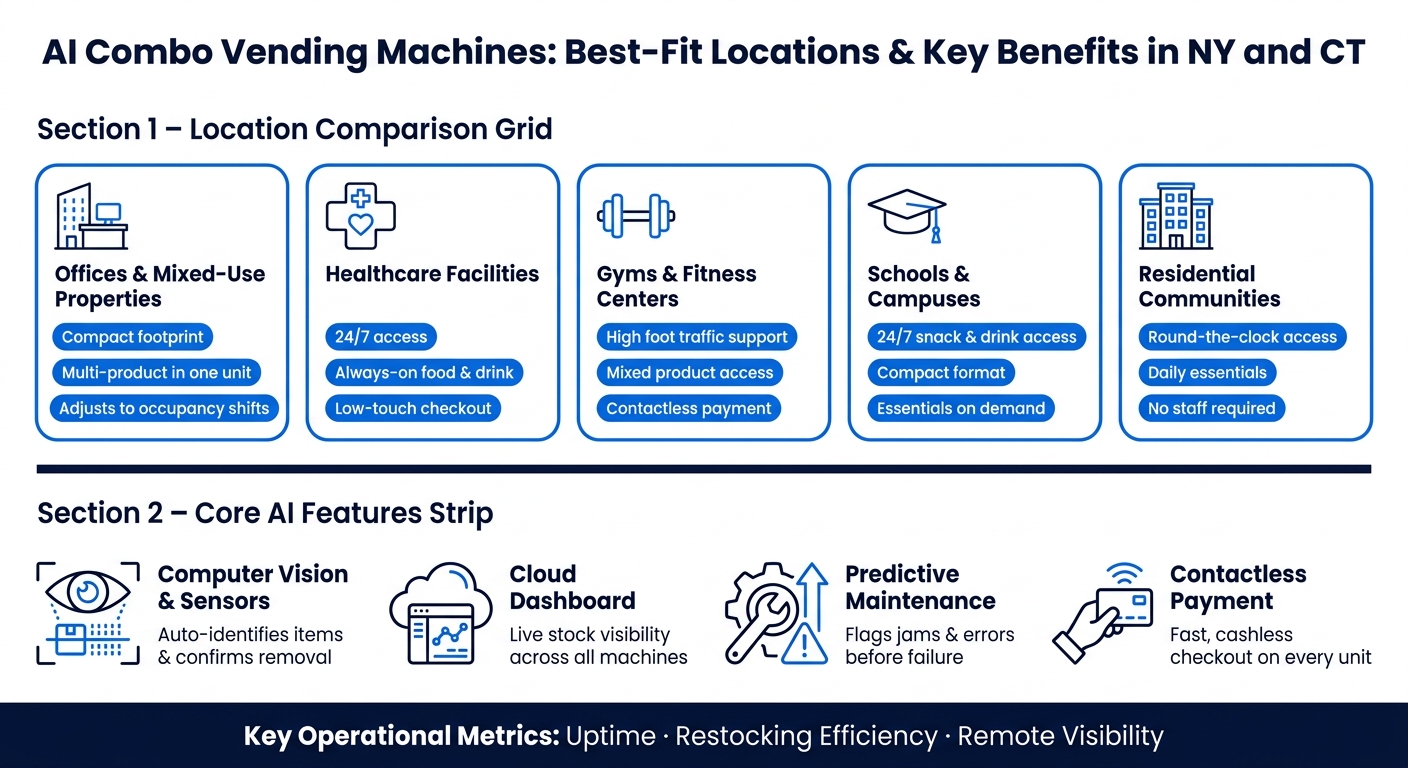
AI Combo Vending Machines: Best-Fit Locations & Key Benefits in NY and CT
The same remote-management features that help these machines run better also shape where they show up.
Offices and Mixed-Use Commercial Properties
Offices and mixed-use commercial properties use AI combo machines to offer snacks, drinks, and daily essentials in one compact unit. That setup works well when floor space is tight. Instead of placing separate machines for each product type, one machine can handle multiple categories in the same footprint.
Healthcare Facilities and Fitness Locations
Healthcare facilities and gyms use the same model to make buying simple and stock easier to follow. Both settings see heavy foot traffic across the day, so low-touch, always-on access to mixed products fits how people move through those spaces.
Schools, Campuses, and Residential Communities
Schools, campuses, and residential communities are also part of the NY and CT locations served. Like healthcare and fitness sites, these places need steady 24/7 access to snacks, drinks, and essentials in a compact format.
These deployment patterns lead directly into the effect on inventory, uptime, and revenue.
Operational Impact: Inventory, Uptime, and Revenue
Those capabilities show up in day-to-day operations across properties in NY and CT.
The research leans heavily toward operations, not finance. It points to better inventory visibility, restocking triggered by sales and stock thresholds, and steadier uptime in high-traffic locations. But there still isn’t enough data to put hard numbers on revenue or cost performance.
Inventory Efficiency and Machine Reliability
One of the biggest changes is moving away from fixed restocking schedules. Instead of visiting machines just because the calendar says so, operators can route service based on sales activity and stock thresholds. That means visits happen when they’re needed, not just when they’re due.
Issues like jams or payment-reader errors can also be flagged before they turn into long stretches of downtime. Add predictive alerts and centralized dashboards, and operators get tighter control over machine performance across multi-site deployments.
That matters most in places where access has to stay steady and staffing is thin, especially healthcare settings. The same goes for offices, gyms, campuses, and residential properties across NY and CT, where dependable access and real-time oversight stay near the top of the list.
For multi-site facilities, that control is the main day-to-day advantage.
Cost, Revenue, and User Experience
The sources don’t support a quantified comparison of revenue, cost, shrink, or payback across machine formats. What they do support is the operational value of AI combo machines: better inventory tracking, remote monitoring, and more steady reliability.
For properties in NY and CT, the takeaway is simple: the main value of AI combo machines is operational control, especially where dependable access, real-time oversight, and restocking triggered by sales and stock thresholds matter most.
These patterns set up the final takeaways for NY and CT properties.
Conclusion: What the Research Suggests for NY and CT Properties
Taken together, the adoption data and day-to-day findings point in one direction: AI combo machines work best as operational tools. For properties in NY and CT, the main upside is better control over service and more steady uptime.
That plays out a little differently from site to site. Healthcare locations gain a lot from 24/7 access, since staff and visitors still need food and drinks when cafeterias are closed. Corporate offices and mixed-use properties get a compact amenity that can adjust as occupancy shifts, without the need for on-site staff.
The metrics that matter most are uptime, restocking efficiency, and remote visibility.
A managed service model also takes pressure off facility teams. When installation, restocking, and maintenance are handled by an outside provider, facility managers don’t have to deal with the daily work of machine upkeep.
For NY and CT properties looking into this option, MotoSnax Vending offers free, fully managed AI-powered combo machine solutions, including installation, maintenance, restocking, and real-time inventory management. That gives properties in NY and CT the operational upside without adding extra logistics.
FAQs
How do AI combo machines stay stocked?
AI-powered combo machines stay stocked with a full-service setup, so site managers don’t have to deal with inventory themselves.
MotoSnax Vending uses built-in tech to monitor real-time inventory and machine health. That lets the team check stock needs from offsite and handle regular restocking and maintenance without guesswork.
Routine onsite visits help keep each machine clean and working the way it should.
What locations benefit most from AI combo machines?
AI-powered combo vending machines fit best in places where people expect convenience and up-to-date amenities.
That usually means luxury residential communities, offices, newly renovated amenity spaces, fitness centers, community rooms, healthcare facilities, and professional workplaces.
MotoSnax Vending supports these spaces across NY and CT with real-time inventory management, contactless payment, and service shaped around each facility’s needs.
What does a managed service include?
A managed service from MotoSnax Vending gives you a worry-free setup by taking care of both equipment upkeep and the day-to-day needs of each machine.
That covers installation and placement, regular maintenance, restocking, and real-time inventory monitoring. So your team can offer quality amenities with very little hands-on work.