If you run combo vending machines, the main choice is simple: do you want software that shows stock and sales, or a service that also handles restocking for you?
I’d sum up the article like this:
- MotoSnax Vending is the only full-service option in this group, and it serves New York and Connecticut sites.
- Cantaloupe Seed, Nayax Core, and Parlevel VMS focus on telemetry, so you can track SKU sales and stock levels as they change.
- Trax Retail focuses on computer vision, which helps check what is physically on shelves, not just what sales data says.
- The comparison looks at 4 things: inventory visibility, demand forecasting, assortment planning, and managed service.
- For combo machines, this matters more because you’re balancing cold drinks at 38°F and ambient snacks in one cabinet.
If I were reading this to make a fast decision, here’s the short answer:
- Pick telemetry-first software if your main goal is live stock tracking and route timing.
- Pick vision-based software if shelf checks and slot compliance matter most.
- Pick MotoSnax if you want someone else to handle how a vending machine works (including restocking and maintenance) in NY/CT.
Quick Comparison
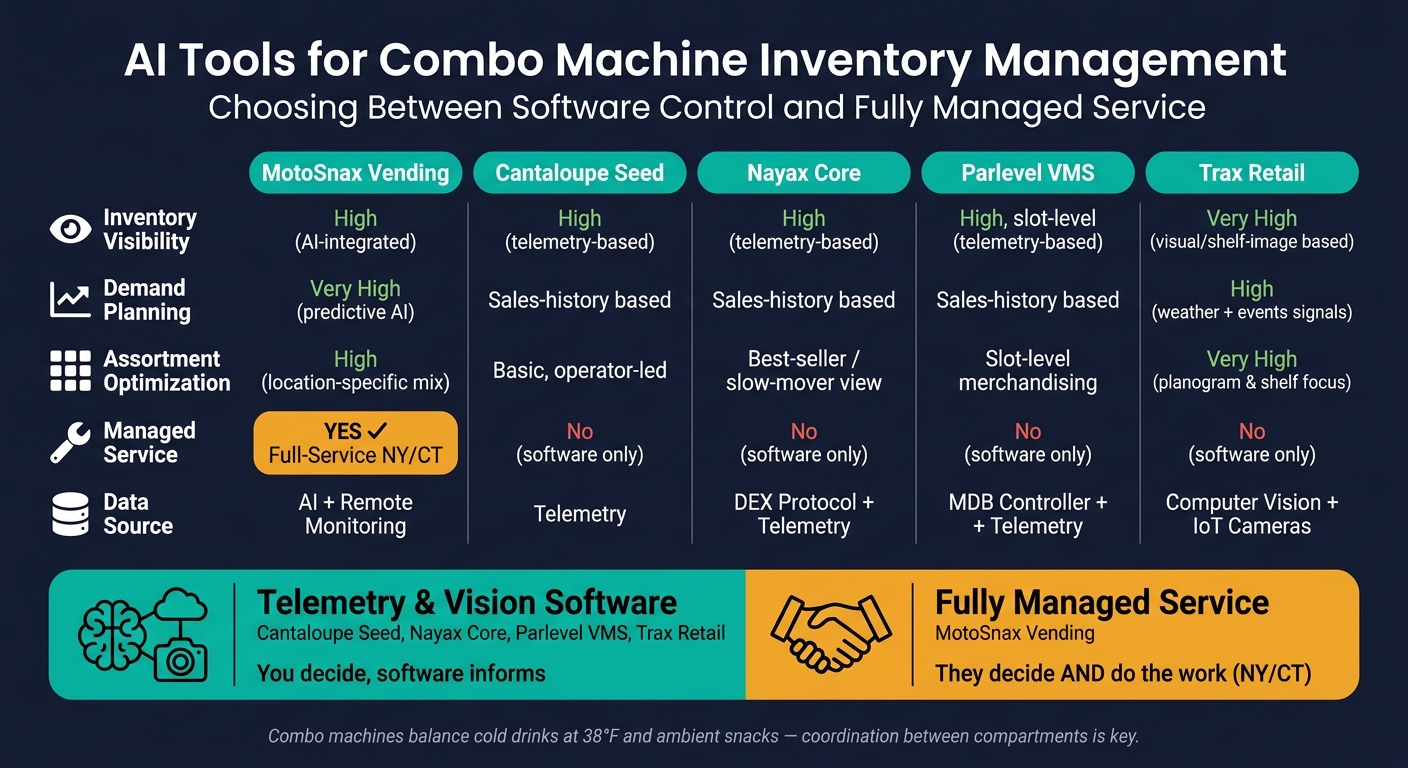
AI Vending Tools for Combo Machines: Side-by-Side Comparison
| Tool | Inventory Visibility | Demand Planning | Assortment Planning | Managed Service |
|---|---|---|---|---|
| MotoSnax Vending | High | High | Location-based mix | Yes |
| Cantaloupe Seed | High | Sales-history based | Basic, operator-led | No |
| Nayax Core | High | Sales-history based | Best-seller/slow-mover view | No |
| Parlevel VMS | High, slot-level | Sales-history based | Slot-level merchandising | No |
| Trax Retail | Very high, shelf-image based | High, with weather/events | Shelf and planogram focused | No |
Bottom line: I see two camps here: software that helps you decide, and a service that both decides and does the work. That split is the main point of the article.
sbb-itb-aa27f9f
1. MotoSnax Vending
MotoSnax Vending offers a fully managed combo-machine service that includes remote inventory monitoring, restocking, and maintenance. If you’re in the NY or CT region, installation comes with no upfront cost. For combo machines, the big draw is simple: live stock control plus a product mix that fits each location.
Inventory Visibility
MotoSnax uses remote monitoring to show live sales and stock levels by SKU, which cuts down on manual checks. The cloud-based dashboard keeps inventory counts and sales reports up to date, so the facility team doesn’t have to handle those tasks by hand.
Demand Planning and Assortment Optimization
The product mix can be customized for each location and updated through the managed service. That makes it easier to match selection to offices, gyms, and healthcare facilities. Remote monitoring and automated alerts also help with on-time replenishment and lower the need for manual oversight.
2. Cantaloupe Seed
Cantaloupe Seed is a vending management platform that uses telemetry to trigger service when it’s needed, instead of sending crews out on fixed schedules. For combo machine operators, that change matters because it affects how restocking is timed across both compartments.
Inventory Visibility
Cantaloupe Seed tracks sales in real time, so operators get a live look at what’s selling in each machine.
Demand Planning and Assortment Optimization
Public materials lean more on telemetry and routing than on SKU-mix planning. Still, operators can use sell-through data to see which snacks and drinks earn more space. For combo machines, it makes sense to check how the platform handles assortment, low-stock alerts, and replenishment rules.
Managed Operations
That live sales data also drives service scheduling. Seed Pro prioritizes visits based on time to empty, so combo machines get serviced when either side is close to running out. Routes are built from sales telemetry, not fixed schedules. In plain English, restocking stays tied to actual sell-through across both compartments. For operators, the upside is fewer wasted visits and faster restocking calls.
3. Nayax Core
Nayax Core is a vending management system built around Nayax payment terminals like Onyx and VPOS Touch. Because the hardware and software work together, payment and inventory data stay synced. That link matters for combo machines, where operators need to match stock decisions with what people are buying.
Inventory Visibility
Nayax Core pulls stock data straight from the combo machine’s controller through the DEX (Digital Exchange) protocol. That gives operators SKU-level counts for each slot. If stock runs low or a machine has a health issue, alerts show up in the MoMa mobile app right away, so field techs know what to expect before they get on-site.
Demand Planning and Assortment Optimization
The platform creates Pick Lists and Pre-kitting reports that show staff what to load before a route starts. That makes it easier to balance snack and drink assortment by location. It also helps spread space between snacks and drinks in a smarter way.
Nayax Core also points out slow movers and best sellers in each machine. So if space is tight, operators can give more room to faster-moving snacks or drinks. That planning also feeds into route timing and restock priority.
Managed Operations
Route planning in Nayax Core is based on days-to-empty forecasting, not a fixed weekly schedule. Machines are prioritized by how close they are to running out of top-selling items, which helps cut extra stops.
The dashboard also reconciles cashless sales, cash counts, and inventory depletion. That’s useful when a combo machine is handling both card and cash transactions across two product categories.
4. Parlevel VMS
Parlevel takes inventory control all the way down to the slot level. It connects to a combo machine’s MDB controller through Parlevel Pay or Parlevel Link, which gives operators real-time stock visibility across both snack and beverage sections.
Inventory Visibility
Parlevel tracks inventory at the coil level, so each slot is monitored on its own. Sales data syncs to the cloud in real time, which means operators can spot low stock without sending someone out to check the machine in person.
That level of detail makes assortment decisions much easier. Slow movers can lose space, while top sellers get more room. Instead of guessing what should go where, operators can use slot-by-slot sales data to make the call.
It also helps with routing. Service trips can line up with actual sell-through, not just a fixed calendar.
Managed Operations
Parlevel’s dynamic routing sends drivers to the machines that actually need service. That cuts unnecessary stops and keeps labor focused where it matters most.
The same data also helps operators rebalance snack and drink assortment by slot. If an item isn’t moving, it can be scaled back. If it’s selling fast, it can earn more space.
5. Trax Retail
Trax Retail uses computer vision and IoT shelf cameras to track combo machine inventory in real time.
Inventory Visibility
Trax spots false out-of-stocks by comparing shelf images with the layout plan. Its image recognition can also tell apart lookalike snack packs and drink labels, even when lighting inside the machine is uneven. That matters more than it sounds. When the system knows what sits on each shelf, operators can rebalance snacks and drinks faster. That shelf-level view also feeds the forecast and assortment calls that come next.
Demand Planning
Trax predicts sell-through using sales history along with local signals like weather and events. For combo machines, that means a spike in cold drink demand tied to a nearby event can be separated from slower snack sales, so replenishment timing stays on track. Those forecasts also make it clearer which SKUs deserve more shelf space.
Assortment Optimization
Trax reviews product performance at the shelf level and recommends which snacks and beverages to stock based on local preferences. It also helps operators give priority to eye-level slots, which tend to drive the strongest sales across both compartments. And when seasonal items start to lose steam, operators can swap them out and move stronger core products into those spots.
Managed Operations
Trax uses AI alerts to send field staff only when a machine needs attention, such as a beverage stockout. By linking shelf-state data to a VMS, it helps line up physical counts with sales data. Put together, these functions show how Trax ties inventory checks, replenishment, and assortment control into one operating flow.
How the Tools Differ Across Inventory, Forecasting, Assortment, and Operations
These tools mainly differ in three areas: where the data comes from, how deep the forecasting goes, and who actually handles replenishment. Put simply, they fall into two camps: software that helps you decide and a service that makes the decisions and carries them out.
Combo machines have a tricky job. They need to balance cold drinks with ambient snacks, and those two sides don’t always move the same way. Telemetry-first platforms like Cantaloupe Seed, Nayax Core, and Parlevel VMS give operators solid real-time stock visibility and route management. That’s a big deal for day-to-day control. But when it comes to assortment, their guidance tends to lean on top sellers.
Trax Retail comes at the problem from a different angle. It uses visual data to spot shelf issues that telemetry can miss. That extra shelf-level detail makes it a better fit for assortment compliance and planogram enforcement across both the snack and beverage sides of a combo machine.
MotoSnax Vending stands apart because it isn’t just software. It works as a managed service, using AI to handle product selection and restocking for locations in New York and Connecticut based on demand at each site.
The table below sums up those differences across the four criteria used in this article.
| Tool | Inventory Visibility | Demand Planning | Assortment Optimization | Managed Operations |
|---|---|---|---|---|
| Cantaloupe Seed | High (telemetry-based) | Sales-history based | Top-seller based | No (software only) |
| Nayax Core | High (telemetry-based) | Sales-history based | Top-seller based | No (software only) |
| Parlevel VMS | High (telemetry-based) | Sales-history based | Moderate (merchandising tools) | No (software only) |
| Trax Retail | Very High (visual-based) | High (shelf-state data) | Very High (planogram focus) | No (software only) |
| MotoSnax Vending | High (AI-integrated) | Very High (predictive AI) | High (location-specific) | Yes (full-service in NY/CT) |
The biggest dividing line is simple: software-only control vs. managed execution. That split shapes the tradeoffs covered in the next section.
Pros and Cons of Each Option for Combo Machine Inventory Management
Each option lines up with a different way of running a vending business: fully managed service, telemetry-first software, or visual shelf control.
The comparison here zeroes in on what most operators care about day to day: cutting labor, keeping inventory accurate, and deciding how much control they want over product mix and replenishment.
MotoSnax Vending is a fit for operators who want the whole job handled for them in NY and CT. That includes installation, maintenance, restocking, and live inventory control. The tradeoff is simple: you give up some control over assortment and pricing because MotoSnax handles those calls as part of the service.
The software-only options below are better for operators who want to stay more hands-on.
Cantaloupe Seed and Nayax Core work well for telemetry-first operators. Both offer strong remote visibility, but product mix choices still lean mostly on sales history. In plain English, the snack-and-drink balance inside a combo machine still depends on the operator looking at the data and making the right call.
Parlevel VMS is a good match for independent operators who want tighter control over slot-level inventory and replenishment timing. The catch is that it needs compatible hardware and a paid subscription.
Trax Retail brings shelf-level visual monitoring into the mix. That can catch stock gaps that telemetry alone may miss across both compartments. That said, its feature set is a weaker match for standard combo-machine operations.
These tradeoffs lead straight into the final recommendation.
Conclusion
The best AI pick comes down to what matters most to you: live visibility, forecast accuracy, or shelf verification.
If your main goal is tight stock control, go with telemetry. If timing replenishment is the big issue, forecasting-first software makes more sense. And if you need to confirm what’s actually on the shelf, vision tools are the better fit. For combo machines, there’s one extra wrinkle: you have to balance cold drinks and ambient snacks inside the same cabinet.
For operators who’d rather not juggle all of that themselves, MotoSnax Vending offers a fully managed option for NY and CT sites. That includes restocking and real-time inventory control for locations in NY and CT that want a fully managed combo-machine service.
Integrated systems cut manual counts and trigger restocks based on live depletion signals.
With combo machines, coordination between the snack and drink compartments matters more than any one feature on its own. A single system for tracking, forecasting, and replenishment tends to deliver the strongest combo-machine performance.
FAQs
How do AI tools reduce stockouts in combo machines?
AI tools cut stockouts by tracking real-time inventory levels. That means operators can restock based on what’s actually running low instead of taking a guess.
They can also watch inventory and machine health at the same time. So if a machine is close to running empty or starting to have issues, operators can step in before peak demand hits. The result is fewer empty slots and less downtime that could stop sales until someone fixes the machine by hand.
What makes combo machine inventory harder to manage?
Combo vending machines are tougher to run because they stock both snacks and drinks in one compact machine. You’re trying to fit more product types into less space, and that makes restocking a bit of a juggling act. It also makes it harder to track which items are moving fast and which ones are just sitting there.
There’s also the hardware side of it. These machines usually have more moving parts and smaller compressors than machines built for just one job. So when maintenance issues pop up, they can disrupt inventory management faster and with less room for error.
When does a managed vending service make more sense?
A managed vending service makes sense when you want a reliable, modern amenity without putting more on your team’s plate.
It’s a good fit for property managers and facilities directors who need to meet building standards but don’t want to deal with installation, restocking, or maintenance. With a full-service provider like MotoSnax Vending, you get updated, cashless-ready equipment while handing off the day-to-day work.