If you’re looking to add a vending machine to your facility without paying upfront, here’s how the vending machine business works: vending providers offer a no-cost managed vending service. They supply, install, and maintain the machine, earning revenue directly from product sales. Your role? Provide a small indoor space (6–12 sq. ft.), a standard 110V outlet, and cover minor electricity costs (around $15–$25/month). Some providers even share 5%–15% of sales with your facility, potentially earning you $100–$500 monthly in busy locations.
Key Points:
- No upfront cost: Providers handle installation, restocking, and repairs.
- Revenue sharing: Earn 10%–25% of gross sales if your location qualifies.
- Qualifications: Locations with 50–100 daily visitors or 40+ full-time employees typically qualify.
- AI technology: Modern machines use AI for real-time inventory tracking and maintenance alerts, reducing downtime.
To get started, assess your foot traffic, choose the right machine (snack, beverage, combo, etc.), and partner with a reliable provider like MotoSnax Vending. They offer free installation, AI-powered machines, and 10% revenue sharing. Ensure your space meets basic requirements, and you could have a vending machine up and running in 2–3 weeks.
How No-Cost Vending Works
What "No Cost" Vending Actually Means
With no-cost vending, the vending provider takes care of everything – supplying, installing, and maintaining the machine – without any upfront charges. All you need to provide is a small space, access to a standard 110V power outlet, and cover minor electricity costs, which typically range between $15 and $25 per month per machine [3].
"Zero upfront cost! We provide free installation, equipment, maintenance, and restocking. You only benefit from the revenue share on sales." – MotoSnax Vending [1]
This arrangement is designed to be hassle-free for the host, with the added benefit of shared revenue. Let’s dive into how a vending machine works.
Revenue Sharing and Agreement Structures
The revenue-sharing model ensures that both the vending provider and the host benefit from product sales. Typically, providers share 10% to 25% of gross sales with the host. In busy locations, this can translate to $100–$500 in monthly earnings [9]. However, not every location qualifies for free machine placement. Providers usually prioritize spaces with daily foot traffic of at least 50 to 100 people. For low-traffic areas, some vendors may offer a subsidized option where the host pays a small monthly fee – usually between $50 and $200 – to guarantee specific inventory or offer reduced product prices for employees [3].
"Free vending machine placement is one of the most misunderstood opportunities in commercial real estate. The sweet spot is a location with 200–500 daily visitors who have at least 3–5 minutes of dwell time. That combination consistently produces $300–800 in monthly commissions." – Marcus Chen, Vending Industry Analyst [9]
This balance of traffic and commissions is key to making the model work. But what keeps operational costs low enough to sustain this setup? The answer lies in AI technology.
How AI-Powered Vending Keeps Costs Down
AI technology is a game-changer for vending providers, helping them cut operational costs while maintaining efficiency. Real-time inventory tracking ensures that restocking happens only when needed – typically one to three times a week – reducing waste and downtime [1]. Advanced systems like smart coolers use computer vision and weight sensors to monitor customer selections with 99.9% accuracy. This minimizes shrinkage and ensures the product selection matches customer preferences. Additionally, remote monitoring allows providers to detect and address technical issues immediately, often resolving them before anyone on-site even notices a problem [1].
"Our remote monitoring technology allows us to respond quickly and keep machines stocked and operational." – MotoSnax Vending [1]
sbb-itb-aa27f9f
Does Your Facility Qualify for a No-Cost Vending Machine?
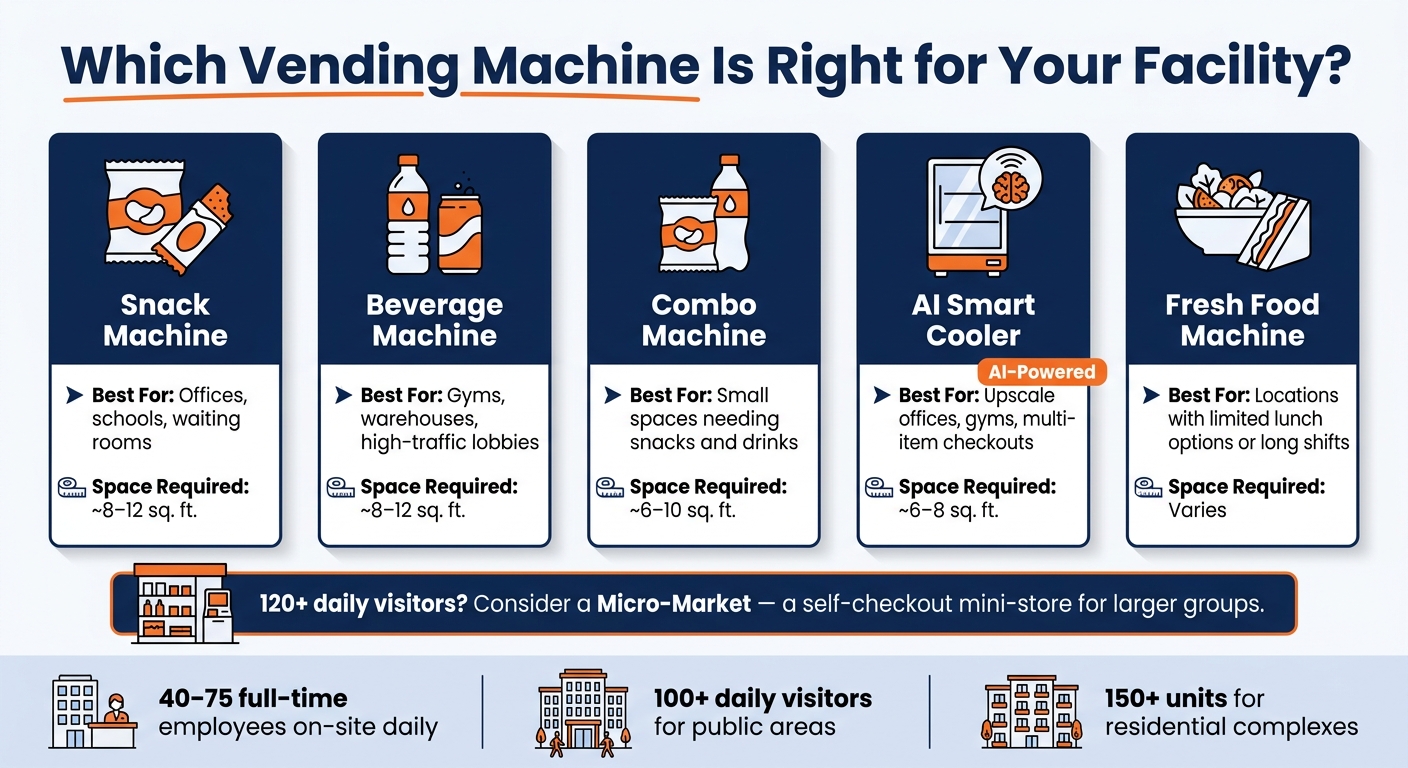
No-Cost Vending Machine Types: Which One Is Right for Your Facility?
Facilities must meet specific sales benchmarks to qualify for a free vending machine. These benchmarks ensure the vending provider can cover operating costs while offering your facility a hassle-free, revenue-sharing setup. Before reaching out to a provider, it’s smart to evaluate your facility’s potential demand. Reviewing real talk from the field can help you understand the nuances of local operations.
How to Estimate Foot Traffic and Demand
The key factor here is the number of people present on-site daily. For offices, vending providers usually require between 40 and 75 full-time employees working on-site each day[4][7]. Public areas like lobbies or gyms typically need 100 or more daily visitors[7]. For apartment complexes, the standard is 150 or more units[4].
When calculating these numbers, focus on employees or visitors who stay on-site during breaks. Also, consider whether nearby cafeterias or convenience stores already serve the same group.
"A warehouse with three shifts of 20 people each can work better than an office with 50 people who all leave for lunch." – Felco Vending[8]
Once you have a traffic estimate, the next step is choosing a vending machine type that fits your facility’s needs.
Choosing the Right Machine Type for Your Facility
After estimating your traffic, match your facility’s needs with the right vending machine. Here’s a quick comparison of common options:
| Machine Type | Best For | Space Required |
|---|---|---|
| Snack Machine | Offices, schools, waiting rooms | ~8–12 sq. ft. |
| Beverage Machine | Gyms, warehouses, high-traffic lobbies | ~8–12 sq. ft. |
| Combo Machine | Small spaces needing snacks and drinks | ~6–10 sq. ft. |
| AI Smart Cooler | Upscale offices, gyms, multi-item checkouts | ~6–8 sq. ft. |
| Fresh Food Machine | Locations with limited lunch options or long shifts | Varies |
If your facility has 120 or more daily visitors and you’d like a broader selection than a vending machine can provide, consider a micro-market. These self-checkout mini-stores offer a variety of products and cater to larger groups[7].
Space, Power, and Accessibility Requirements
Once you’ve selected the right machine, make sure your facility meets the necessary installation requirements. The space should be clean, dry, and indoors – common locations include break rooms, lobbies, or waiting areas. You’ll also need a standard 110V outlet nearby, as extension cords are not recommended due to fire codes[9].
Electricity costs for most vending machines are minimal, averaging between $5.00 and $10.00 per month. If you’re considering a coffee or ice-making machine, ensure there’s a dedicated water line available[4].
Check that hallways, doors, and elevators can accommodate the machine during delivery. For AI-powered or cashless machines, confirm the location has strong WiFi or cellular coverage[2][6]. Lastly, for public-facing setups, ensure the machine is ADA-compliant, with accessible controls and enough clear floor space for all users[5].
How to Choose the Right Vending Partner
Once you’ve confirmed that your facility qualifies and you’ve identified the type of vending machine you need, the next step is finding the right partner. The choice you make here can make or break the no-cost, hassle-free experience you’re aiming for. A poor partner might leave you dealing with empty machines, slow repairs, and a lot of frustration. This is where MotoSnax Vending shines.
What to Look for in a Managed Vending Service
The first and most critical factor is ensuring the agreement is truly zero-cost. This means no hidden fees for installation, maintenance, or repairs. Some contracts might seem free at first but sneak in extra charges through "maintenance agreements." Always get the terms clearly outlined in writing.
Beyond cost, here are a few essential qualities to consider when choosing a vending partner:
- Remote monitoring: Look for a provider that uses AI-powered telemetry and real-time inventory tracking. This ensures they can detect low stock or machine issues before you even notice.
- Quick response times: The best services guarantee same-day responses for outages and resolve other issues within 24–48 hours [1].
- Flexible product selection: A good partner adapts the product mix based on sales data rather than sticking to a fixed lineup.
- Compliance documentation: Make sure the provider can easily supply a W-9 and Certificate of Insurance (COI) when needed [1].
MotoSnax Vending checks all these boxes with its zero-cost, AI-driven, locally managed approach.
"Local ownership means faster response times and personalized service for your location." – MotoSnax Vending [1]
MotoSnax Vending: A Fully Managed, No-Cost Solution
MotoSnax Vending, a firefighter-owned business based in Yonkers, NY, serves Westchester, Rockland, and Putnam counties in New York, as well as Fairfield County in Connecticut [1]. Their model is entirely free for facilities, covering equipment, installation, restocking, and maintenance.
What makes MotoSnax stand out is their AI-powered smart coolers. These machines use computer vision to track inventory with 99.9% accuracy in real time [1]. Customers simply tap to unlock the cooler, grab what they need, and are automatically charged when the door closes – all in under 60 seconds [1].
"Zero management overhead – we handle installation, monitoring, restocking, and maintenance so your team stays productive." – MotoSnax Vending [1]
Facilities can also benefit from a 10% revenue share on sales. Plus, MotoSnax offers referral rewards between $500 and $1,000, along with royalties for successful location leads [1].
Before making your final decision, ensure that MotoSnax’s offerings align with your facility’s specific needs.
Matching the Right Service to Your Facility’s Needs
It’s essential to confirm that your chosen provider has experience with facilities similar to yours and can meet your unique demands. For instance, a gym with 200 daily visitors will require a different setup than a small office with 50 employees. The vending solution should match your foot traffic and usage patterns.
If your location sees 75 or more daily users and aesthetics matter – like in a high-end office lobby or corporate gym – opt for providers offering glass-front AI smart coolers instead of traditional coil machines. On the other hand, for busy break rooms or warehouses with multiple shifts, a combo or dedicated beverage machine might be a better fit.
To ensure the partnership meets expectations, consider requesting a 60–90 day trial period before committing to a long-term agreement [5]. This trial will help you confirm that the service level and sales performance are up to par.
How to Set Up and Launch Your No-Cost Vending Program
Once you’ve selected your vending partner, getting your program up and running is a simple process. Follow these steps to ensure everything goes smoothly.
What to Review Before Signing a Vending Agreement
Before you commit to a contract, take the time to carefully review the terms. Look out for potential red flags like long lock-in periods (typically 3–5 years), hefty early termination fees, and auto-renewal clauses that require 60–90 days’ notice to cancel [2]. Addressing these details upfront helps protect the no-cost arrangement and avoids unnecessary complications.
Here are key points to clarify before signing:
- Service response times: Confirm that the provider guarantees same-day responses for outages and resolves minor issues within 24–48 hours [2].
- Restocking schedule: Ensure the agreement specifies how often the machine will be restocked, usually 1 to 3 times per week depending on usage [1].
- Sales minimums: Some contracts allow for the machine’s removal if monthly sales fall below a set threshold, so it’s important to understand this requirement [3].
- Compliance documents: Verify that the provider can supply necessary documents like a W-9 and a Certificate of Insurance (COI) before installation [1].
Preparing Your Site for Installation
Make sure your site is ready for the vending machine by providing adequate floor space and reliable access to power. Refer to the recommended space guidelines for the type of machine you’ve chosen.
You’ll need a dedicated 110V/115V three-prong outlet near the installation area. This is a common cause of delays, so double-check power availability in advance [1]. Also, ensure the delivery crew has a clear path for installation – any obstacles like stairs or narrow hallways could result in additional fees [4].
The installation process itself is quick, typically taking 30–45 minutes. Once installed, the machine is usually up and running within 7–14 days. Keep in mind that electricity costs for vending machines average between $5.00 and $10.00 per month [4].
After installation, regular monitoring will help ensure the machine continues to meet your facility’s needs.
Tracking Performance and Adjusting Over Time
Once your vending program is operational, keep an eye on its performance. Monthly sales reports can help you identify which products are popular and which aren’t. Use this data to make adjustments, like swapping out underperforming items or stocking up on seasonal favorites – think cold drinks during the summer months [1].
"The machine pays for itself over time through product sales. This means our success is directly tied to your machine performing well." – Felco Vending [8]
If your provider offers a digital dashboard, take full advantage of it. Advanced machines, like MotoSnax’s smart coolers, use AI to track inventory with up to 99.9% accuracy. This technology helps you spot trends early and address service gaps proactively [1]. Additionally, placing a QR code near the machine allows employees to easily request new products or report issues, keeping everything running smoothly [1].
Conclusion: Steps to Get a Free Vending Machine for Your Facility
Getting a vending machine for your facility is easier than most people think. From the initial conversation to having a fully stocked machine ready to go, the process usually takes just 2 to 3 weeks. The actual setup? That’s done in as little as 2 to 4 hours [1]. It’s quick and hassle-free.
MotoSnax Vending makes the process even better. There’s no upfront cost, their machines use advanced AI for efficiency, and they handle everything. Plus, if your location has high foot traffic, you could bring in an estimated $5,544 a year through their 10% revenue-sharing program [1].
Ready to take the next step? Reach out to MotoSnax Vending at info@motosnaxvendingny.com to arrange your free consultation. All you need is a busy indoor space and a standard 110V outlet to get started.
FAQs
What’s the catch with “no-cost” vending?
The key to no-cost vending lies in meeting specific usage expectations. Vendors supply the equipment and handle maintenance, but they usually expect your location to hit minimum foot traffic or sales goals. If these targets aren’t met, they might take the machine away. Additionally, you’ll need to provide the electricity and space for the machine, and the vendor typically sets the product prices – not you.
How do I know if my facility qualifies?
To be eligible for a no-cost vending solution from MotoSnax Vending, your facility should generally have steady foot traffic of at least 40-50 people daily. This includes employees, customers, or visitors. MotoSnax reviews your location’s available space, traffic flow, and specific requirements to confirm it meets the necessary sales volume. Reach out to us for a quick, customized assessment of your site.
What should I watch for in the contract?
When you’re reviewing a vending agreement, it’s important to prioritize flexibility and transparency. Opt for contracts that are short-term, like month-to-month or one-year agreements, and make sure they include clear exit options without penalties. Steer clear of long-term commitments or auto-renewals that require advance notice to cancel.
Take note of who owns the vending equipment, and be on the lookout for any extra fees – such as charges for installation, removal, or administrative tasks. The agreement should also outline service expectations in detail. This includes how often restocking will occur, how quickly maintenance issues will be addressed, the terms for commissions, and who is responsible for damage or theft.