If I had to sum it up in one line: on-site vending solutions work best where the same people stay for hours, take short breaks, and don’t have many nearby options.
That usually points to five places:
- Corporate offices
- Manufacturing plants and warehouses
- Hospitals and clinics
- Schools, colleges, and universities
- Apartment communities
I’d look for four signs first:
- Repeat traffic matters more than raw foot traffic
- Short break times push people to buy on-site
- Long dwell time keeps demand steady
- Limited nearby food or supply options drives more sales
The numbers in the article back that up. For example, some 24/7 warehouses can do $3,500 to $8,000 per month per machine, while luxury apartment buildings with 200+ units can see $2,000 to $5,000 per month. In many settings, cashless payment can lift spend by 20% to 40%. And if machines sit empty or down, sites can lose 15% to 25% of sales.
If I were choosing where to place vending first, I’d start with locations that have a captive audience, fixed break patterns, and after-hours demand.
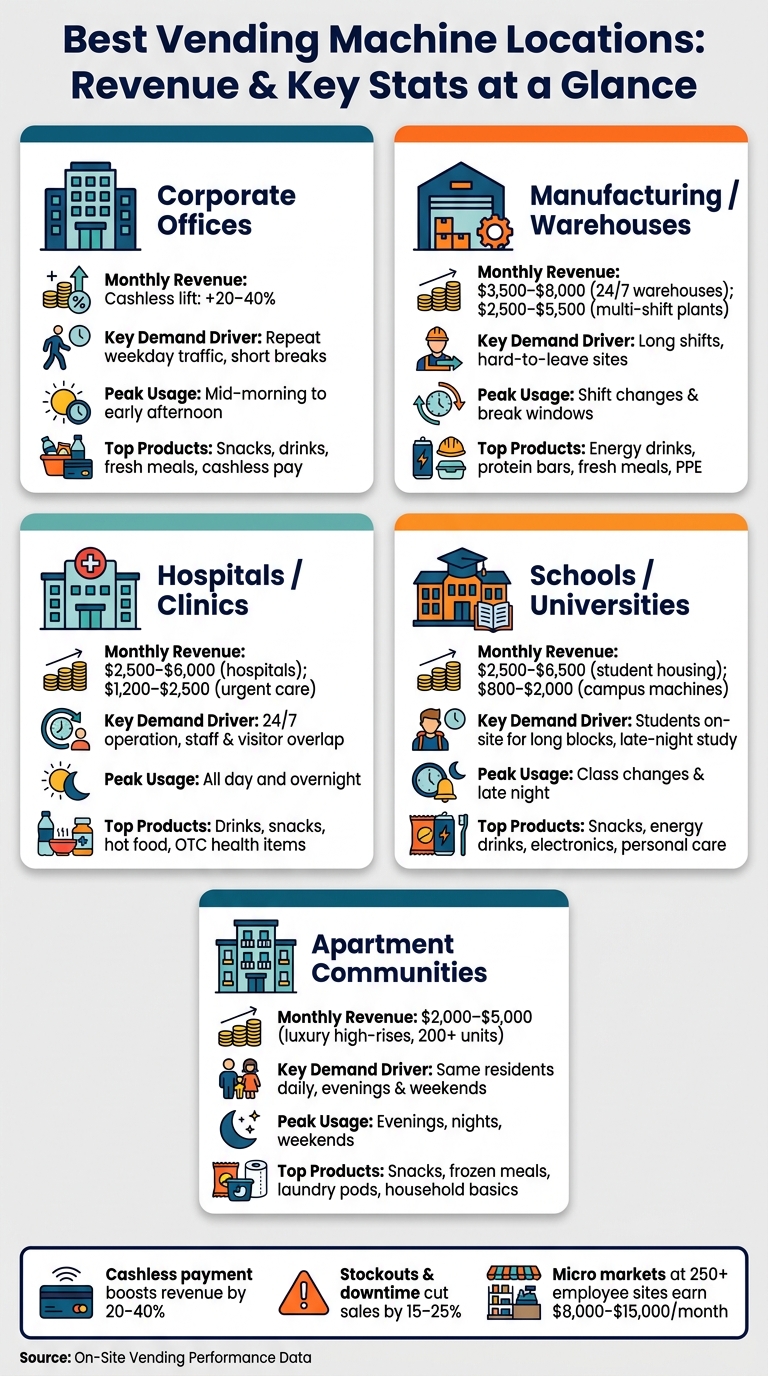
Best Vending Machine Locations: Revenue & Key Stats at a Glance
Quick Comparison
| Location | Why It Works | Common Demand | Typical Focus |
|---|---|---|---|
| Corporate offices | Repeat weekday traffic and short breaks | Mid-morning to lunch | Snacks, drinks, meals, cashless pay |
| Manufacturing / warehouses | Long shifts and hard-to-leave sites | Break windows and shift changes | Energy drinks, meals, PPE, badge access |
| Hospitals / clinics | 24/7 use from staff and visitors | All day and overnight | Drinks, snacks, meals, small health items |
| Schools / universities | Students stay on-site for long blocks | Class changes and late night | Snacks, caffeine, basics, mobile pay |
| Apartment communities | Residents come back every day | Evenings, nights, weekends | Snacks, frozen meals, household basics |
So the main idea is simple: the best vending spots are not always the busiest ones. They’re the ones where convenience changes what people do.
sbb-itb-aa27f9f
What Makes a Location a Good Fit for On-Site Vending
Not every busy place turns into a strong vending spot. The best locations have one thing in common: people stay there long enough for fast access to food and drinks to matter.
Repeat traffic matters more than raw headcount. A smaller site with the same people coming back every day will often beat a bigger site filled with one-time visitors [2]. That steady, predictable demand is what turns vending into a reliable amenity instead of a nice-to-have extra.
Break length matters too. Vending tends to do best when people have short breaks and can’t leave the building to grab something elsewhere [1]. If someone has only a few minutes, a nearby machine stops being optional and starts being useful.
Hours play a big role as well. A 24/7 facility can keep sales going long after a cafeteria shuts down, while a standard office usually sees demand in tighter windows, like midmorning, lunch, and late afternoon [2][1].
Product mix also needs to fit the setting. One machine setup won’t work everywhere. For example:
- Water and snacks fit most locations
- Energy drinks tend to sell well in warehouses
- Coffee drinks and protein items often work better in offices and healthcare settings [4][1]
Payment habits can shape results too. Class A offices and luxury apartment buildings tend to do best with cashless machines, since convenience and larger basket sizes can support higher spending [2][5].
Put all of that together, and it’s easier to see why the five location types below tend to stand out.
1. Corporate Offices and Multi-Tenant Office Buildings
Corporate offices line up well with the core vending model: repeat foot traffic, short breaks, and steady demand for fast, cashless access.
Traffic and Dwell-Time Patterns
Office buildings are a strong fit because weekday traffic is steady and people see the machine again and again. That repeat exposure helps turn one-off purchases into habits. Demand tends to peak from mid-morning through early afternoon, when employees are in the building and don’t have much time to step away for a long break [6][2].
Nearby Retail Limitations
In many office settings, leaving the building eats up too much break time. That makes on-site vending a simple convenience that people use often. In multi-tenant buildings, shared common areas also make placement more efficient, since one machine can serve several tenants without adding staff time [7].
Best-Fit Product Mix and Access Controls
Smaller offices usually perform well with a simple mix of snacks, bottled water, and energy drinks. Larger offices can support micro-markets or smart coolers stocked with fresh meals, premium beverages, and wellness items [2][7].
Smart coolers are a strong option in shared areas because they stay locked until payment is completed, which helps control access [7]. Cashless payment is a must. Tap-to-pay and mobile pay can increase revenue per transaction by 20% to 40% [1][2].
Managed Restocking and Uptime Needs
Office demand often spikes during a few short windows each day. If a top-selling item runs out during the lunch rush, sales disappear fast. Managed vending programs use real-time telemetry to track sales and prompt restocking before shelves empty out [7][1].
Remote monitoring also helps spot machine issues fast, including mechanical faults, temperature alerts, and payment errors. Most providers aim for same-day or next-day service resolution [7]. For office teams, that means less hands-on work and fewer interruptions.
Industrial sites change the demand pattern, but the main idea stays the same: vending works best where people can’t easily leave to grab food or drinks.
2. Manufacturing Facilities, Warehouses, and Industrial Sites
Industrial sites follow the same basic pattern, but shift work changes the rhythm. Demand tends to bunch up around break windows and shift changes, which makes it easier to predict. When people stay on-site for long stretches, vending does more than offer convenience. It also helps keep work moving.
Traffic and Dwell-Time Patterns
Manufacturing plants and warehouses often run 24/7 or across multiple shifts, so demand spikes at shift changes [2][9]. That steady flow can support $3,500 to $8,000 per month per machine in 24/7 warehouses and distribution centers, and $2,500 to $5,500 in multi-shift plants [2].
Those traffic patterns affect more than sales volume. They also shape what machines should carry and who should be able to use them.
Nearby Retail Limitations
Many industrial sites sit in remote areas or big industrial parks with limited food choices close by [2]. Even when a cafeteria is on-site, night-shift workers may not have many options. And if employees leave the building, they can burn 15 to 20 minutes of their break just getting there and back [3]. On-site vending helps fill that hole.
Best-Fit Product Mix and Access Controls
Shift workers usually want food and drinks they can grab fast and take right back to the floor. Protein bars, jerky, 16-ounce energy drinks, and fresh meals like sandwiches, wraps, and breakfast bowls tend to sell well, especially before 8:00 AM and during overnight shifts [3][9]. In sites without a cafeteria, a fresh-food fridge paired with a microwave can be a strong setup [3].
Industrial vending can also handle more than snacks and drinks. Machines may dispense PPE and maintenance items such as:
- Gloves
- Safety glasses
- Batteries
- Tools
Each item can be tied to an employee badge at the time of dispense. That helps support ISO 45001 compliance and gives safety managers a clear audit trail [3]. Many sites link machines to existing RFID employee badges, which keeps transactions fast and simple [3].
Managed Restocking and Uptime Needs
Real-time telemetry and AI-powered monitoring track both inventory and machine health as it happens, so restocking can follow actual demand instead of a fixed route schedule [3][10]. The day-to-day upside is pretty simple: fewer stockouts, fewer manual checks, and tighter control over supply access. Automated industrial vending can trim supply costs by 20% to 30% compared with manual supply rooms [3].
For larger sites, the math can shift again. Facilities with more than 250 employees often have enough demand to support a micro market. Those setups can bring in $8,000 to $15,000 per month and produce 30% to 50% more sales than enclosed machines [2][3].
The same pressure around speed, access, and short breaks shows up in healthcare too, where staff coverage gaps can make on-site options just as important.
3. Hospitals, Clinics, and Healthcare Campuses
Hospitals are one of the best on-site vending locations for a simple reason: they never shut down. They run 24/7, and people often stay inside for hours at a time. That creates steady demand from staff, visitors, and overnight workers who still need food, drinks, and small essentials after cafeterias and gift shops close. The strongest setups line up the machine mix with each area’s foot traffic, access rules, and staffing pattern.
Traffic and Dwell-Time Patterns
Hospitals stay busy across all three shifts. And overnight sales can be higher per visit because there are fewer places open to buy from [2].
On hospital and medical campuses, vending machines often bring in $2,500 to $6,000 per month per machine. Urgent care centers and outpatient clinics tend to average $1,200 to $2,500 per month [2]. In a staff corridor, one machine may serve 90 to 140 daily users and produce $1,100 to $1,600 per month [12].
Nearby Retail Limitations
At night, options shrink fast. That leaves staff and visitors with very few places to grab what they need. On-site vending covers that gap without adding labor.
Best-Fit Product Mix and Access Controls
Hospitals serve two main groups at once: visitors and staff. So the product mix needs to handle both comfort buys and actual shift-break meals.
Lobbies and waiting rooms often do well with:
- Healthy snacks
- Water and other hydration options
- Charging accessories
- Diabetic-friendly items
Staff corridors and break rooms usually need more filling options, like energy drinks, protein snacks, and hot food. Nurse stations are often a better fit for compact tabletop units. Some hospitals also use specialized vending for PPE, scrubs, or approved supply-room items, usually with staff oversight.
Contactless payment is a must. It can increase revenue by 20% to 30% [12].
Managed Restocking and Uptime Needs
After-hours demand makes uptime more important here than in many daytime-only sites. If a hospital machine is out of service or empty, sales disappear fast. A top-performing unit can lose about $1.80 in gross revenue per hour when it’s down [12].
That’s why real-time alerts matter. If the system flags jams, faults, or low stock right away, operators can step in before the problem drags on. Par-level restocking also helps keep best-selling items in place during overnight and weekend peaks, when service visits tend to happen less often [12].
Machines placed near patients should also be ADA-compliant and low-noise [11].
4. Schools, Colleges, and Universities
Educational campuses are a strong fit for vending. Students spend long stretches on-site, and they want fast access to snacks, drinks, and day-to-day basics. The best spots are the ones students pass again and again – dorms, student unions, libraries, and study halls.
Traffic and Dwell-Time Patterns
Campus demand tends to come in waves. You see it during class changes, evening study sessions, and the steady flow in and out of residence halls. So instead of a flat sales pattern, machines often get short, predictable bursts throughout the day and late into the night.
Student housing machines can bring in between $2,500 and $6,500 per month during peak semesters [2]. Campus machines more often fall between $800 and $2,000 per month [6]. Sales are highly seasonal. The strongest stretch usually runs from August through April, with clear dips during summer and semester breaks [6][2].
Nearby Retail Limitations
Late-night demand is often where campus vending shines. Off-campus stores may be closed, and even when they are open, they can be too far away for a student with a short break between classes or a late study block.
Best-Fit Product Mix and Access Controls
Product mix should match the setting. Hallways and student lounges tend to do well with standard snacks and drinks. Dorms and study areas often move more energy drinks and other high-caffeine items because of late-night routines [12].
Campus machines can also go well beyond chips and soda. Many now stock electronics, personal care items, and hot meals [8].
One thing is non-negotiable: cashless payment. On campuses, it can increase revenue by 20% to 30% [12].
Managed Restocking and Uptime Needs
None of that matters if the machine is empty at the wrong time. Popular items need to stay in stock during class changes and late-night peaks. Students usually won’t stop to report an empty machine – they just keep walking [12].
That matters more than it may seem. Stockouts and machine faults can quietly cut 15% to 25% of possible sales [12]. And a three-day outage at a strong campus machine can cost more than $130 in gross revenue [12].
Sales data helps here. It shows which products sit too long and which ones move fast, so operators can swap out weak sellers before they drag down results. That pattern makes campuses a strong fit for AI-driven inventory tracking and remote restocking.
5. Apartment Communities and Residential Buildings
Apartment communities are strong vending spots because the same people use them again and again. Residents are on-site 24/7, so demand tends to climb after work, late at night, and on weekends. That pattern matters. Apartments tend to work best when the audience is made up of repeat users, not passersby.
Traffic and Dwell-Time Patterns
That repeat usage makes placement a big deal. Laundry rooms, gyms, and package-lobby areas usually work best because residents already spend time there. You’re not asking people to make a special trip. The machine is right where they already pause.
Nearby Retail Limitations
If someone wants one snack, one drink, or one basic item, leaving the property often feels like a hassle. Delivery apps can help, but small orders often come with an extra $5 to $10 in fees and tips [9]. An on-site machine cuts out that hassle and gives residents instant access without having to head out.
Best-Fit Product Mix and Access Controls
In residential settings, machines tend to do better when they carry more than candy and soda. Basics like laundry pods, toothpaste, and over-the-counter medicine can sell well, along with frozen meals and late-night snacks [7][9].
Access setup should match the building:
- Use locked machines in smaller buildings
- Use app- or card-locked coolers in higher-end properties that want fresh food and premium drinks
Managed Restocking and Uptime Needs
Because resident demand is spread across evenings and weekends, restocking should follow actual usage instead of a fixed route. That’s one reason managed service works well here. The operator handles installation, stocking, and maintenance, which keeps the workload off property staff [7].
Downtime can quietly eat into sales. Jammed validators or faults that no one reports can cut 15% to 25% of potential sales if they aren’t caught fast [12]. And when a machine is empty or broken, the issue isn’t just lost revenue. It also hurts the amenity experience for residents.
Telemetry-based monitoring helps operators catch issues early and restock based on what people are buying [7][12]. In luxury high-rises with 200+ units, monthly vending revenue can range from $2,000 to $5,000 [2]. At that level, the service model makes sense, and AI-powered monitoring with remote alerts can give operators a clear edge.
How AI-Powered Managed Vending Fits Each Setting
AI-powered managed vending adjusts stocking, access, and uptime based on the setting, traffic flow, and break schedule. The same system can handle very different needs in offices, plants, hospitals, campuses, and apartment buildings.
At the center of managed vending is telemetry. Real-time sales data helps stop stockouts and keeps top-selling items available. Automated alerts also help fix machine issues before a short outage turns into a bigger problem. That matters when people rely on fast access to things like energy drinks in warehouses, fresh meals in hospitals, or snacks in places where traffic spikes happen at set times.
Cashless, contactless payment is now standard. It helps speed up each purchase and works especially well in places where people want fast service, cleaner checkout, or late-night access without hassle.
For many facilities, managed service also cuts the day-to-day workload. It can include the equipment, installation, stocking, and maintenance with little upfront cost. And instead of guessing what people want, operators can adjust the product mix based on actual buying behavior.
The next section looks at how a vending machine works and how those needs shift from one location to another.
Side-by-Side Comparisons by Location Type
These tables show how access, inventory, and staffing change from one setting to another. Put simply: vending priorities shift based on where the machine goes and who uses it.
Office breakroom: on-site access vs. off-site trips
The main difference here is time saved.
| Feature | Without Vending | With Managed Vending |
|---|---|---|
| Employee Travel | 15–20 min off-site runs for food or drinks [3] | Instant on-site access, 24/7 [7] |
| Product Freshness | Limited to items brought from home | Fresh meals and snacks restocked via data [7] |
| Payment | No machine available | Cashless payment: card and mobile [7] |
| Management Effort | Staff manually shops and stocks | Provider handles all inventory and maintenance [7] |
When food and drinks are available on-site, employees don’t need to leave the building for a quick snack, coffee, or lunch. That can make a big difference in offices where short breaks tend to stretch into 15 to 20 minutes off-site [3].
Manufacturing: what each shift actually needs
Shift-based demand shapes the product mix. A machine stocked for day shift won’t do much for the night crew.
| Shift | Primary Need | Ideal Inventory |
|---|---|---|
| Early Morning (Pre-8 AM) | Breakfast and energy | Breakfast items and coffee [3] |
| Day Shift | Quick lunch and hydration | Lunch items and hydration drinks [3] |
| Night/Overnight | High energy and warmth | High-energy snacks and hot food [3] |
| All Shifts | Safety and maintenance | PPE and maintenance supplies [3] |
A factory runs on timing. Early crews often want breakfast and coffee. Day shift leans toward lunch and drinks. Overnight staff usually need higher-energy snacks and something warm [3]. Across all shifts, PPE and maintenance items also matter [3].
Hospital cafeteria vs. managed vending
Hospitals need vending that fills the gaps a cafeteria leaves behind.
| Feature | On-Site Cafeteria | Managed Vending |
|---|---|---|
| Availability | Limited meal windows | 24/7 [1][3] |
| Staffing Required | Full kitchen and service staff | Unmanned [3] |
| Product Range | Full hot meals | Fresh grab-and-go, salads, OTC medications [1][2] |
This is where round-the-clock access matters most. Hospital staff, visitors, and even patients may need food, drinks, or basic health items outside normal meal hours. A cafeteria can cover main dining periods, but managed vending extends access to 24/7 without adding kitchen or service staff [1][3].
K-12 vs. university vending requirements
Access rules, compliance needs, and payment methods differ a lot between these two settings.
| Feature | K-12 Schools | Universities |
|---|---|---|
| Primary Goal | Healthy alternatives and compliance | Convenience and 24/7 access [1] |
| Key Locations | Cafeterias, staff rooms | Dorms, libraries, lounges [1] |
| Inventory | Healthy snacks and drinks | Late-night meals and caffeine [1] |
| Payment | Cash or card | Meal plans, student accounts, mobile [1] |
K-12 schools tend to focus on healthier options and rule compliance. Universities usually lean harder into convenience, longer access hours, and payment options that fit campus life, like meal plans, student accounts, and mobile pay [1].
Apartment communities: placement by traffic zone
In residential buildings, placement matters just as much as product mix. A machine in the lobby will usually get more use than one tucked away in the basement.
| Location | Traffic Type | Ideal Inventory |
|---|---|---|
| Lobby / Lounge | High – entry and exit flow | Coffee, fresh meals, luxury snacks [1] |
| Gym / Fitness Center | High – active users | Protein bars, electrolytes, recovery drinks [1][2] |
| Laundry Room | Steady – waiting residents | Detergent pods, snacks, soda [1] |
The pattern is pretty simple. High-traffic areas support grab-and-go food and drinks, while utility spaces like laundry rooms work well for both convenience items and snacks. In other words, the best placement matches the resident’s routine [1].
Conclusion
The five locations covered here – offices, industrial sites, healthcare facilities, schools, and apartment communities – all have one thing in common: people want fast access to food, drinks, and day-to-day items without leaving the building.
The best vending locations tend to share a few simple traits. How long people stay matters. So does how close they are to other places to buy snacks, meals, or basics. And the product mix has to line up with what people there actually want. If a site has a captive audience and few nearby options, a well-stocked machine can get steady use. That steady use is what drives results.
That’s where AI-powered managed vending stands out. It helps keep service dependable with real-time inventory tracking, cashless payments, and provider-managed stocking and maintenance. When those parts work together, vending stops being just a convenience and starts to feel like a dependable facility amenity.
For facilities looking at vending, the main question is simple: is the site a good fit? That comes down to location, traffic patterns, and a product mix that matches the people using the space every day.
FAQs
How do I know if my site is a good fit for vending?
A strong vending location usually comes down to three things: steady foot traffic, a captive audience, and a clear reason people would want easy access to products.
It also helps if you can make a simple case to the property owner or manager. Convenience matters. So does user satisfaction. In some places, a vending machine can even make day-to-day operations run more smoothly.
The machine itself should fit the setting, too. A health-focused machine makes sense in places like gyms or schools. On the other hand, contactless, cashless machines are often a better match for hospitals, airports, and office buildings, where people want fast, low-friction purchases.
What products should a vending machine carry for my location?
The right product mix comes down to where the machine is placed and what people there are most likely to need in the moment.
Hospitals tend to sell more OTC medications, hot foods, and healthier snacks. In office settings, snacks and drinks usually lead the way, with healthier picks doing well too.
Apartments and dorms often have steady demand for frozen meals, coffee, ice cream, and travel-size essentials. Fitness centers are a good match for protein shakes, electrolyte drinks, and better-for-you snacks. Hotels and transportation hubs usually do best with grab-and-go snacks, beverages, and travel essentials.
When should I choose a machine instead of a micro market?
Choose a vending machine over a micro market when space is tight, foot traffic is moderate, and the main goal is fast access to snacks and drinks.
It works well in smaller spots like breakrooms, hotel corridors, gym lobbies, and apartment common areas. And if you have fewer than 150 daily users, a vending machine can be a lower-cost, easier-to-manage choice than a micro market.