AI-powered vending machines fix the biggest vending problem: not knowing what is in each machine until someone checks it. I’d sum it up like this: live stock tracking helps cut stockouts, lower waste, trim labor, and improve buying decisions.
If I were explaining it in plain English, here’s the short version:
- Manual checks waste time and money because teams follow fixed routes instead of restocking based on actual need.
- Live inventory data shows what each machine has by product, not just by location.
- Low-stock alerts tell teams when to refill before slots go empty.
- Forecasting tools use sales patterns, shift timing, seasonality, weather, and local events to estimate demand.
- Product-level data helps remove slow sellers and stock more of what people buy.
- Better purchasing data can cut costs by 10% to 15% and improve forecast accuracy by 10% to 20%.
This matters most in places like offices, hospitals, gyms, apartments, and schools, where people expect 24/7 access to food or supplies. When a machine is empty, the problem is not just lost sales. It also wastes staff time and hurts service.
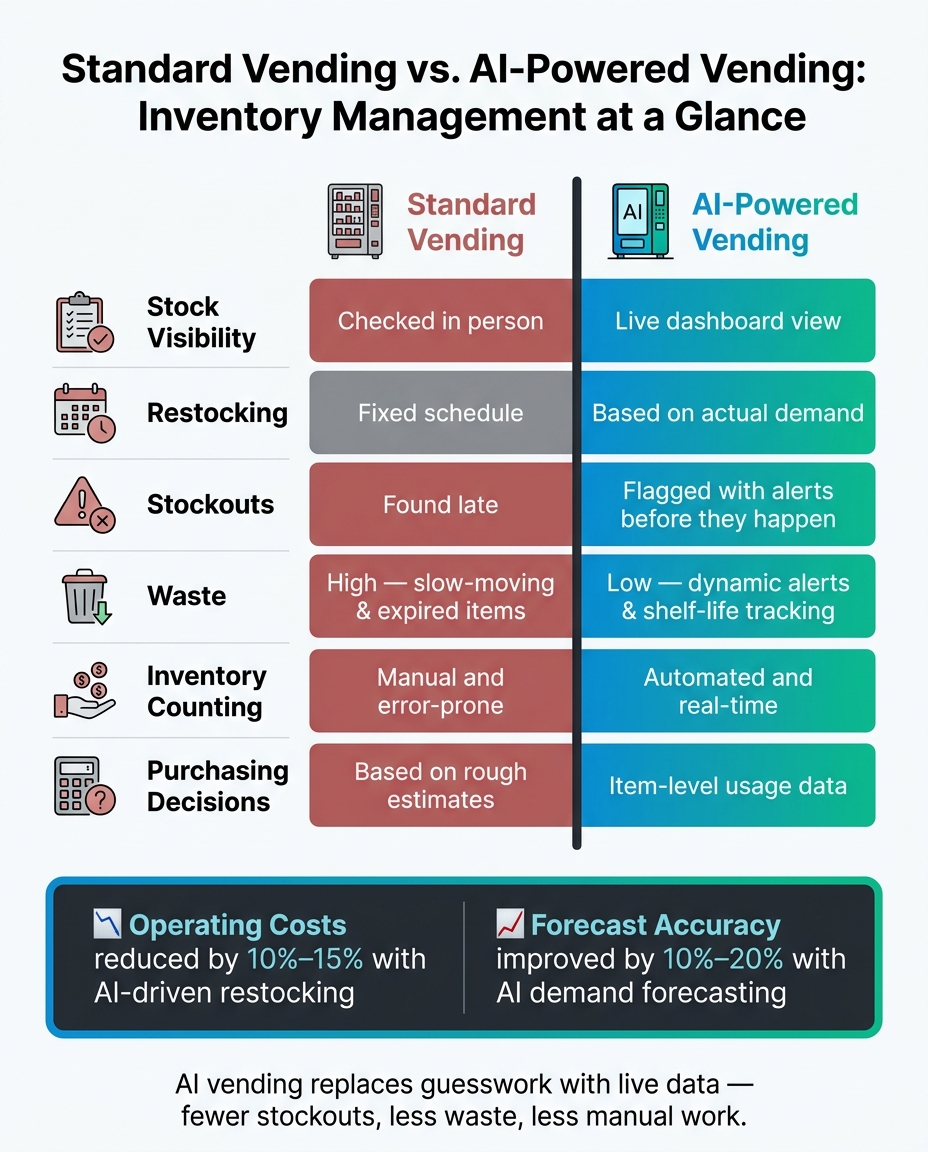
Here’s the core idea in one glance:
| Issue | Standard vending | AI-powered vending |
|---|---|---|
| Stock visibility | Checked in person | Seen live on a dashboard |
| Restocking | Fixed schedule | Based on actual demand |
| Stockouts | Found late | Flagged with alerts |
| Waste | More slow-moving and expired items | Lower waste from better tracking |
| Counting | Manual | Automated |
| Purchasing | Based on rough counts | Based on item-level usage data |
I see the article’s main point as simple: when vending runs on live data instead of guesswork, inventory gets tighter control, service gets more reliable, and day-to-day work gets easier.
The rest of the article explains how tools like computer vision, weight sensors, RFID, alerts, and demand forecasting work together to make that happen.
Standard Vending vs. AI-Powered Vending: Inventory Management Compared
Common Inventory Problems in Standard Vending
Traditional vending keeps inventory out of sight until someone checks the machine in person. Sales data also tends to stay on the machine until a worker pulls it on-site. That lag leads to stock gaps before anyone sees the problem. In practice, it shows up as empty slots and missed service chances.
No Real-Time Visibility by Machine or Product
Most fixed routes follow a set schedule instead of actual demand. So if a machine sells out on Saturday, it stays empty until the next visit. In a 24/7 place like a hospital, that gap is more than a hassle. It becomes a service problem for staff who rely on the machine during a night shift or over the weekend.
There’s also no remote way to check stock, alerts, or machine status between visits. That’s the gap real-time tracking fills.
Stockouts, Overstock, and Waste Happen at the Same Time
It’s a strange but common vending problem: one machine sits empty while another is packed with slow-moving items that may expire. That ties up cash in product that doesn’t sell.
The issue hits fresh food and healthier grab-and-go items even harder. Because they have a shorter shelf life, even small swings in demand can hurt. Standard machines don’t track those shifts well. The result is spoilage at full cost. Managed AI-powered modern vending machine solutions help balance stock across machines.
Manual Counting Makes Purchasing Less Accurate
Manual counts create mistakes at every handoff: warehouse, van stock, and machine. One bad count can turn into a bad order. On top of that, manual counts and data-entry errors skew purchase orders and make reordering less precise.
AI tracking cuts those mistakes by updating counts automatically between visits.
sbb-itb-aa27f9f
How AI-Powered Vending Machines Fix Inventory Blind Spots
AI fixes inventory blind spots by tracking stock all the time between service visits. Instead of waiting for the next refill check, operators get a live view of what’s inside each machine. That view comes from machine vision, sensors, and item-level tracking.
Real-Time Inventory Tracking with Computer Vision, Sensors, and RFID
AI vending machines use computer vision, shelf sensors, and RFID to track stock in real time. Computer vision identifies products by their shape and packaging. When someone removes an item, the system logs it right away and updates a dashboard. It also tracks returns, which helps keep counts accurate.
Weight-sensing technology picks up tiny shifts in weight the moment a product is lifted. That gives operators a full shelf view, even when lighting is poor. RFID tags add another layer. Each item gets a digital ID, so the machine can tell exactly what was taken and what is still there.
Put together, these tools close the inventory gap between service visits and cut down on manual counting.
Low-Stock Alerts and Automated Reordering
Once the machine has live inventory data, the next step is doing something with it before a slot runs empty. AI systems let operators set threshold alerts. When a product drops below a set count, the system sends an automatic notice to the service team. That helps crews restock before users run into empty slots.
Machine learning also predicts how fast items will sell and flags the right reorder timing. That lets service teams build pre-packed route kits for each machine ahead of time, so drivers bring only what that stop needs. The result is fewer wasted trips and less extra stock sitting unsold.
Comparison Table: Core AI Capabilities vs. Inventory Problems Solved
These tools each handle a different part of the inventory problem.
| AI Capability | Inventory Problem Solved | Operational Benefit |
|---|---|---|
| Computer Vision | Miscounts & product substitutions | Identifies items by visual shape and packaging; tracks returns accurately |
| Weight Sensors | Blind spots & lighting issues | Full shelf visibility, even in poor lighting |
| RFID Monitoring | Unknown removals between visits | Tracks exact products taken or remaining in real time |
| Low-Stock Alerts | Stockouts | Notifies service teams before a slot goes empty |
| Demand Forecasting | Waste & overstock | Predicts future needs based on actual usage patterns |
| Live Dashboard | Manual counting errors | Shows current stock across machines without manual checks |
How AI Improves Forecasting, Product Mix, and Purchasing
Once stock levels are visible in real time, that same data can do a lot more than show what’s on hand. It can shape what gets reordered, what stays in the machine, and what should be removed. Real-time tracking is just the starting point. The bigger payoff comes when AI uses that data to help facilities make better calls going forward.
Demand Forecasting Based on Actual Usage Patterns
Once live inventory is captured, AI uses it to predict what each machine will need next. This goes far beyond looking at last week’s sales. AI can analyze time of day, day of week, seasonality, and shift patterns, along with factors like weather and local events, to predict what each specific machine will need and when.
That machine-by-machine view matters. A machine in a corporate office won’t behave like one in a plant or a gym. People buy different items at different times depending on the location. So instead of leaning on a network-wide average, AI builds a separate forecast model for each machine based on its own buying patterns.
That leads to tighter planning. AI-driven demand forecasting typically improves accuracy by 10% to 20%, which helps cut stockouts and keep inventory leaner.
Those same usage signals also make it easier to see which products are worth their space.
Better Product Mix and Lower Waste
Once AI has enough history to work with, it starts showing which products are pulling their weight. Item-level analytics highlight top sellers and slow movers for each individual machine, not just across the full account. If an item has no sales for 14 days, the system can flag it for rotation and open that slot for something people are more likely to buy.
This is even more useful for facilities that stock perishables. Slow movers can quietly eat into margins if no one catches them in time. AI can spot those items early and trigger markdowns before they expire.
In plain terms, shelf space stops being a guessing game. It becomes a data-based call.
That product mix data also helps clean up purchasing decisions and tighten budget control.
More Accurate Purchasing and Budget Planning
Usage-based data closes the gap between what facilities think they need and what they actually use. AI systems track item-level margins along with sales volume, so buyers can make decisions based on profit by slot, not just revenue at the top. That makes it easier to favor items that sell at a steady pace and support stronger margins.
On the budget side, real-time visibility into slow movers helps facilities avoid overbuying and cut the cost of expired inventory. AI can also bring sales, inventory, service schedules, product costs, and purchasing into one view. When purchasing is driven by demand instead of guesswork, operating costs can drop by 10% to 15%.
Operational Benefits for Facilities and Conclusion
What Facilities Gain from AI-Powered Inventory Management
AI-powered inventory management cuts down on stock checks, restocking coordination, and service gaps. That means less day-to-day labor and fewer service interruptions. Property staff no longer have to check inventory or manage routine restocking and maintenance. The vendor takes care of that remotely using live data.
When restocking is based on actual demand, operating costs can drop by 10% to 15% compared with fixed-schedule service. Automated inventory tracking also removes many of the manual counting mistakes that often lead to stock mismatches and wasted product.
Predictive maintenance helps keep products fresh and machines up and running. AI watches cooling temperatures and motor performance around the clock, then flags issues before users notice anything is wrong. That helps facilities avoid last-minute fixes while keeping machines stocked with fresh items.
Comparison Table: Standard Vending vs. AI-Powered Vending
At the operational level, AI changes both service work and purchasing decisions.
| Feature | Standard Vending | AI-Powered Vending |
|---|---|---|
| Waste | High due to static expiration tracking | Low; dynamic pricing and shelf-life alerts |
| Labor | High; fixed routes and manual counts | Low; automated alerts and optimized routes |
| Maintenance | Reactive; fixed after failure | Predictive; self-diagnostics flag issues early |
Conclusion: Better Inventory Control Leads to Better Facility Service
Better visibility leads to better stocking, faster service, and less waste. AI-powered vending replaces a reactive, labor-heavy process with one that runs on data, automation, and actual demand. Real-time stock visibility, low-stock alerts, demand forecasting, and usage-based tracking work together to cut waste, reduce manual work, and keep machines stocked with the right products at the right time.
For facilities, that means fewer stockouts, less waste, and less manual work.
FAQs
How does AI know what was taken from a vending machine?
AI-powered vending machines track inventory by pulling sales and transaction data from the machine’s controller, often through DEX protocols.
Some setups also use weight sensors, optical sensors, or computer-vision cameras to tell when items are dispensed, picked up, or put back. That information goes to a cloud dashboard, giving operators real-time stock visibility.
Can AI-powered vending work with fresh food and perishable items?
Yes. AI-powered vending works well for fresh food and other perishable items.
It can monitor temperature in real time, which helps support food safety and warns operators before swings start to hurt product quality. That matters a lot when you’re selling items with a short shelf life.
AI-powered vending also uses computer vision and usage-based analytics to track inventory with more precision. In plain terms, operators can see what’s selling, what’s sitting, and what may expire soon. That can help cut waste and make it easier to manage perishable stock.
Another plus: AI can support dynamic pricing. So as items get closer to expiration, the system can discount them automatically instead of letting them go unsold.
What kind of data does AI use to predict restocking needs?
AI predicts restocking needs by pulling in real-time data, including sales by slot, purchase history, and peak demand times by day or hour.
It also looks at local events, weather, seasonal patterns, warehouse inventory, expiration dates, and machine-level data like temperature, payment status, and hardware health. Put it all together, and you get a forecast built for each location instead of a one-size-fits-all guess.