If I had to boil it down to one line: pick a smart cooler for meal-heavy sites with controlled access, and pick a combo vending machine for public spaces that need simple snack-and-drink sales.
Here’s the short answer:
- Smart coolers fit sites that want meals, salads, sandwiches, yogurt, and premium drinks.
- Combo vending machines fit sites that want chips, candy, bottled drinks, and other packaged items.
- Smart coolers often cost more upfront: about $4,000 to $12,000, plus $40 to $100 per month for software and connectivity.
- Combo machines usually cost less: about $1,200 to $3,500 used or $4,500 to $6,500 new.
- Combo machines tend to be the safer pick for public, high-theft, or rough-use areas.
- Smart coolers are often a better fit where people want more than soda and snacks and where access is somewhat controlled.
If I were checking a site, I’d focus on four things first:
- Traffic: Is there enough daily use to support a cooler?
- Security: Is the area public or monitored?
- Product mix: Do people want meals or just packaged snacks and drinks?
- Space: Can the site handle a bulkier machine, or is floor space tight?
The big takeaway: the machine should match the location. A smart cooler can do well in offices, hospitals, large apartment buildings, and some gyms. A combo machine often makes more sense in small offices, K-12 schools, laundry rooms, and industrial floors.
Quick Comparison
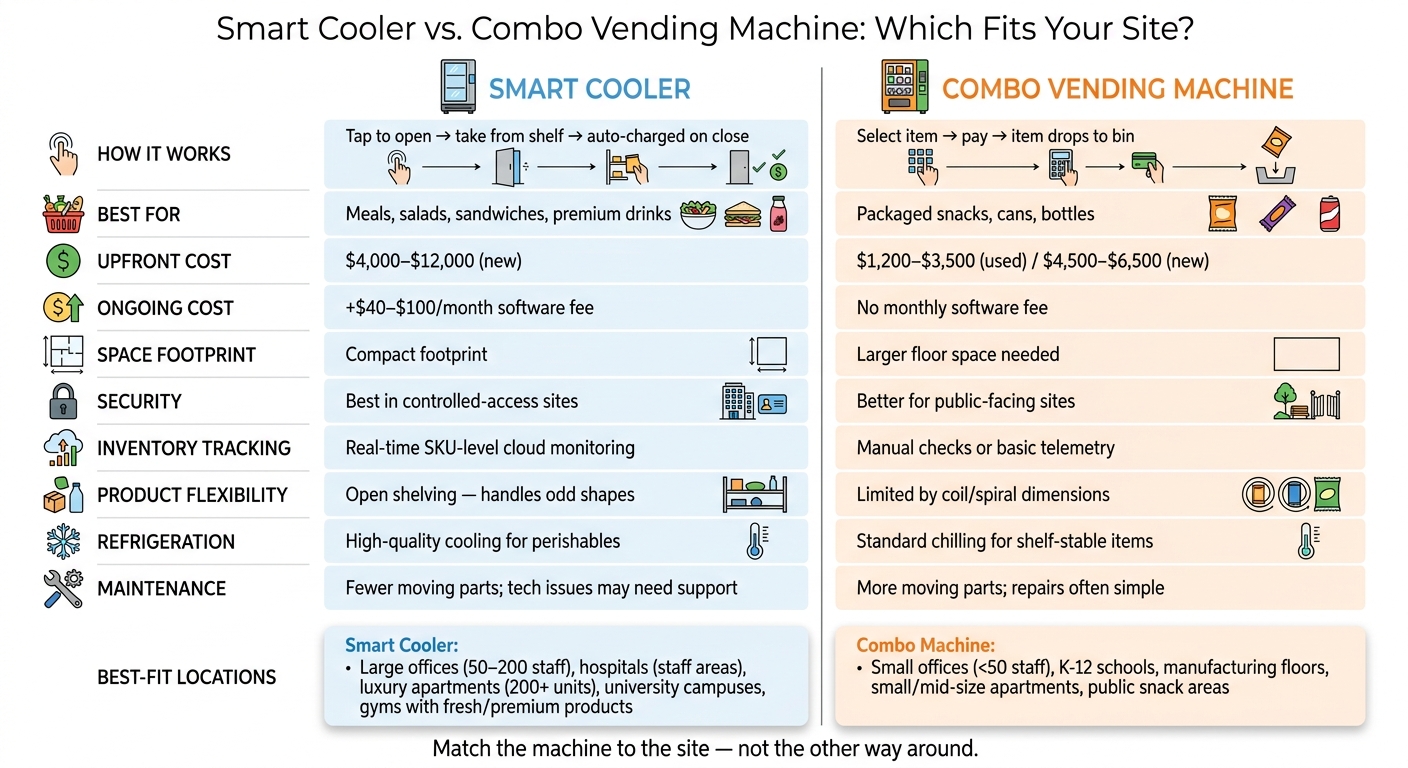
Smart Cooler vs. Combo Vending Machine: Side-by-Side Comparison
| Criteria | Smart Cooler | Combo Vending Machine |
|---|---|---|
| How the vending business works | Tap to access, take from shelf, charged after door closes | Pick item, pay, item drops to bin |
| Best for | Meals, salads, sandwiches, premium drinks | Packaged snacks, cans, bottles |
| Item shapes | Handles odd shapes well | Best for standard packaged items |
| Space | Usually takes less room | Usually needs more floor space |
| Security | Better in controlled-access sites | Better for public-facing sites |
| Inventory view | Real-time SKU tracking and stock alerts | Basic telemetry or manual checks |
| Cooling use | Better suited for perishable food | Better suited for shelf-stable snacks and cold drinks |
| Repairs | Fewer moving parts, but tech issues can need support | More moving parts, but many fixes are simple |
| Cost | $4,000–$12,000 new + $40–$100/month | $1,200–$3,500 used or $4,500–$6,500 new |
| Best-fit locations | Offices, hospitals, large apartments, gyms with meal/drink focus, campuses | Small offices, K-12 schools, industrial sites, public snack areas |
A simple rule helps: if your users want meals, I’d lean cooler. If they want grab-a-snack convenience, I’d lean combo. For those in the Tri-State area, we offer modern vending machine solutions at no cost to your business.
sbb-itb-aa27f9f
How Each Machine Type Works
The main difference is pretty simple: smart coolers use shelf access, while combo machines use item dispensing.
Smart Coolers: Locked, AI-Enabled Refrigerated Units
A smart cooler is a locked refrigerated cabinet that tracks inventory on its own and lets people take items only after they authenticate with a card, mobile wallet, or app. The door stays locked until the user taps to verify access. After it opens, the customer grabs items straight from the shelf. When the door closes, the system figures out what was removed and charges the customer automatically [5][1].
Operators can check sales and inventory in cloud dashboards. They also get low-stock and expiration alerts [5][2]. Because these units have fewer moving parts, they can cut down on repair needs.
That makes smart coolers a better match for grab-and-go fresh food, while combo machines are a better match for packaged products.
Combo Vending Machines: Snacks and Cold Drinks in One Cabinet
A combo vending machine puts snacks and cold drinks in one cabinet [2]. Snacks are dispensed through spiral coils, while bottles and cans are stored in a refrigerated section [2][3]. The customer picks an item, pays, and collects it from the bin.
Many combo units connect to cloud dashboards for remote sales, inventory, and temperature tracking [2][8]. They work best for packaged snacks, bottled drinks, and steady demand, not fresh food or odd-shaped packages [4][1].
That makes combo machines a strong fit for classic snack-and-drink sales.
Side-by-Side Comparison: Key Differences for Decision-Makers
Once you understand how vending machines work, the choice usually comes down to four things: space, access, product type, and cost.
Space, Security, and User Experience
Smart coolers take up less room than most combo machines. That makes them a better fit for tighter spots where every inch counts. Combo machines are usually wider and more bulky, so they need more floor space.
Security is another big dividing line. Combo machines keep every item locked behind glass until payment goes through, which helps keep shrinkage very low [3][6]. Smart coolers are a better match for places with some level of oversight or controlled entry, like offices, apartment communities, gyms, and hospitals.
The buying process feels different too. Combo machines use a simple pick-pay-collect flow. Smart coolers use a tap-to-open setup. That more direct flow can help drive more frequent purchases.
ADA access can also tilt the decision. With smart coolers, once the door is open, users can reach shelves more easily. Combo machines may be harder to use depending on how high the delivery bin sits.
Product Range, Inventory Visibility, and Refrigeration
| Feature | Smart Cooler | Combo Vending Machine |
|---|---|---|
| Product Range | Fresh meals, salads, odd-shaped items, premium drinks | Standard packaged snacks, cans, bottles |
| Inventory Tracking | Real-time, SKU-level cloud monitoring | Manual checks or basic telemetry |
| Refrigeration Quality | High-quality cooling for perishables and fresh food | Standard chilling for shelf-stable items |
| Product Flexibility | Open shelving – supports irregularly shaped items | Limited by coil or spiral dimensions |
This is where the gap gets pretty clear.
Combo machines are tied to whatever fits inside a coil or spiral. That makes them a good pick for packaged snacks, cans, and bottles. Smart coolers use open shelving, so operators have more room to stock fresh meals, salads, premium bottled drinks, and other items that don’t fit the neat little vending-machine mold.
Maintenance, Payments, and Cost
Combo machines have more moving parts, including coils, delivery bins, and other mechanical hardware. Over time, those parts can wear down. The upside is that single repairs are often fairly simple and not too expensive. Smart coolers have fewer parts that can jam, which helps on the mechanical side, but sensor or camera problems can call for more technical support.
Cost is one of the biggest differences. Used combo machines usually cost $1,200–$3,500, while new models tend to land around $4,500–$6,500. Smart coolers usually start higher, at $4,000–$12,000 new, and they also come with a monthly software and connectivity fee of $40–$100 [6].
Those tradeoffs play out in different ways depending on the site.
Best Fit by Location Type
The best choice usually comes down to how people use the space. Machine category matters, sure, but location type often settles the decision once you’ve looked at space, traffic, and product mix.
Offices, Apartments, and Gyms
For a mid-size office, a smart cooler is often the better pick. People in that setting usually want actual lunch options, not just chips and soda. Sites that switched have reported employee satisfaction scores for breakroom amenities rising by as much as 40% [5].
A smaller office with fewer than 50 staff is a different story. In that case, a combo machine is often the better call because the vending machine ROI is often better because the upfront cost is lower [4][9].
Apartment buildings follow a similar pattern. Smart coolers fit luxury or large complexes with 200+ units, where fresh food can feel like a strong amenity rather than just a nice extra [10]. Smaller buildings, or busy shared areas like laundry rooms, tend to be a better match for a combo machine [10].
Gyms depend a lot on the product mix. If the goal is to sell protein shakes, pre-workout drinks, or fresh wraps, a smart cooler makes more sense [3][7]. If it’s a smaller fitness space that mainly needs bottled water and shelf-stable snacks, a combo machine can do the job just fine [4].
Hospitals, Schools, and Industrial Sites
The same basic pattern shows up in busier or more sensitive settings, but here security and durability carry more weight.
Hospitals are a strong fit for smart coolers, especially in staff areas where workers need fresh meals during long shifts [3][1].
K-12 schools usually fit combo machines better because they’re more durable and easier to control in high-traffic settings [3][1]. University campuses are different. Late-night demand for fresh food makes smart coolers a better fit there [4][1].
On industrial floors, combo machines tend to work best for fast coffee, energy drinks, and packaged snacks. Smart coolers fit better in administrative wings and break areas where people want something closer to a meal [10][3].
| Location Type | Better Fit | Primary Reason |
|---|---|---|
| Large Corporate Office (50–200 employees) | Smart Cooler | Fresh meals and higher engagement [5] |
| Small Office (<50 staff) | Combo Machine | Lower cost [4][9] |
| Luxury or Large Apartment Complex (200+ units) | Smart Cooler | Premium fresh-food amenity [10] |
| Small/Mid-Size Apartment Building | Combo Machine | Lighter traffic and basic snack needs [10] |
| Gym with Fresh or Premium Products | Smart Cooler | Supports irregular shapes and higher-value items [3][7] |
| K-12 School | Combo Machine | Durability and security [3][1] |
| University Campus | Smart Cooler | Late-night fresh food [4][1] |
| Manufacturing Floor | Combo Machine | High-volume packaged snacks [10][3] |
| Hospital (Staff Areas) | Smart Cooler | Fresh meals on long shifts [3][1] |
How to Choose and Next Steps
If both machines still look good on paper, use traffic, access, and product mix to make the call.
When a Smart Cooler Is the Better Fit
Go with this option when fresh food is the main draw.
A smart cooler works best in a controlled-access location with 100+ daily visitors. It’s a strong match for fresh meals, salads, yogurt, sandwiches, and premium drinks [1][5][4].
When a Combo Vending Machine Is the Better Fit
Choose this option when packaged snacks and simple operation matter most.
A combo machine fits public-facing, low-traffic sites that mostly need packaged snacks and bottled drinks [6][9]. Its locked-glass design helps cut shrinkage, and used units start at about $1,200 [6][9].
Pick the format that fits the site, the user, and the operating model.
Key Takeaway for Site Operators
Match the machine to the site, not the other way around. A smart cooler in a high-theft public space is a poor fit [3][4]. A combo machine in a busy corporate office may leave money on the table.
For the final site check, look at traffic, security, space, and product mix.
FAQs
How much traffic does a smart cooler need?
A smart cooler tends to work best in places with at least 100 visitors a day. If foot traffic is lower, especially under 50 daily visitors, a standard vending machine is often enough.
Where smart coolers shine is in closed or secure settings with a steady group of users. In those spots, people tend to care more about convenience, a broader product mix, and the simple grab-and-go experience.
Which option is easier to maintain?
It comes down to what matters more to you: mechanical simplicity or digital efficiency.
Traditional vending machines are often easier to service. Their motors and coils are simple, predictable, and familiar to most techs.
Smart coolers, on the other hand, have fewer moving parts. That can mean fewer repairs over time. They also give you real-time inventory tracking and automated restocking alerts, which can make day-to-day management a lot easier.
Can one site benefit from both?
Yes. Many sites do well with a hybrid setup that uses both options.
A combo vending machine gives people a familiar, lower-cost way to buy packaged snacks and drinks. A smart cooler adds grab-and-go fresh meals and drinks that don’t work well in coil-based machines.
Used together, they cover more needs, make buying easier, and can help bring in more total revenue.