If I want a vending machine to stay compliant, I check four things first: DOE limits, ENERGY STAR listing, site setup, and service records. For refrigerated beverage vending machines in the U.S., the main pass/fail point is whether the unit meets the DOE daily energy limit for its equipment class and still runs with the same settings and parts tied to its listed configuration.
Here’s the short version:
- Start by understanding how the machine works: model number, serial number, manufacture date, and location
- Confirm the equipment class: Class A, Class B, Combination A, or Combination B
- Check energy use: compare measured kWh/day against the DOE rule in 10 CFR Part 431, Subpart Q
- Verify ENERGY STAR only by exact model match in the EPA database
- Inspect low-power settings: sleep mode, lighting, fans, compressor controls, and add-on devices
- Review installation: leave 4 to 6 inches of rear clearance and match power supply to the nameplate
- Keep service logs per machine: installation notes, repairs, software changes, and review dates
A few numbers matter here. Rear spacing should stay at 4 to 6 inches where the maker calls for it. Energy use is tracked in kWh/day. Review records should show dates in MM/DD/YYYY or YYYY-MM-DD, as long as I use one format every time.
The core idea is simple: a machine can meet the rule on paper and still drift out of line after a move, repair, software update, or accessory install. So I treat compliance as a recordkeeping and inspection job, not just a one-time purchase check.
| Check area | What I look for | Why it matters |
|---|---|---|
| DOE rule | Correct class and kWh/day limit | This is the federal requirement |
| ENERGY STAR | Exact model listing and listed data | Listing applies to specific setups |
| Machine settings | Low-power mode, lights, fans, controls | Changed settings can increase energy use |
| Site setup | Clearance, airflow, voltage, amperage, grounding | Bad setup can push usage up |
| Records | One file for each machine | Makes audits and reviews much easier |
Below, I break this into a simple checklist I can use for each unit.
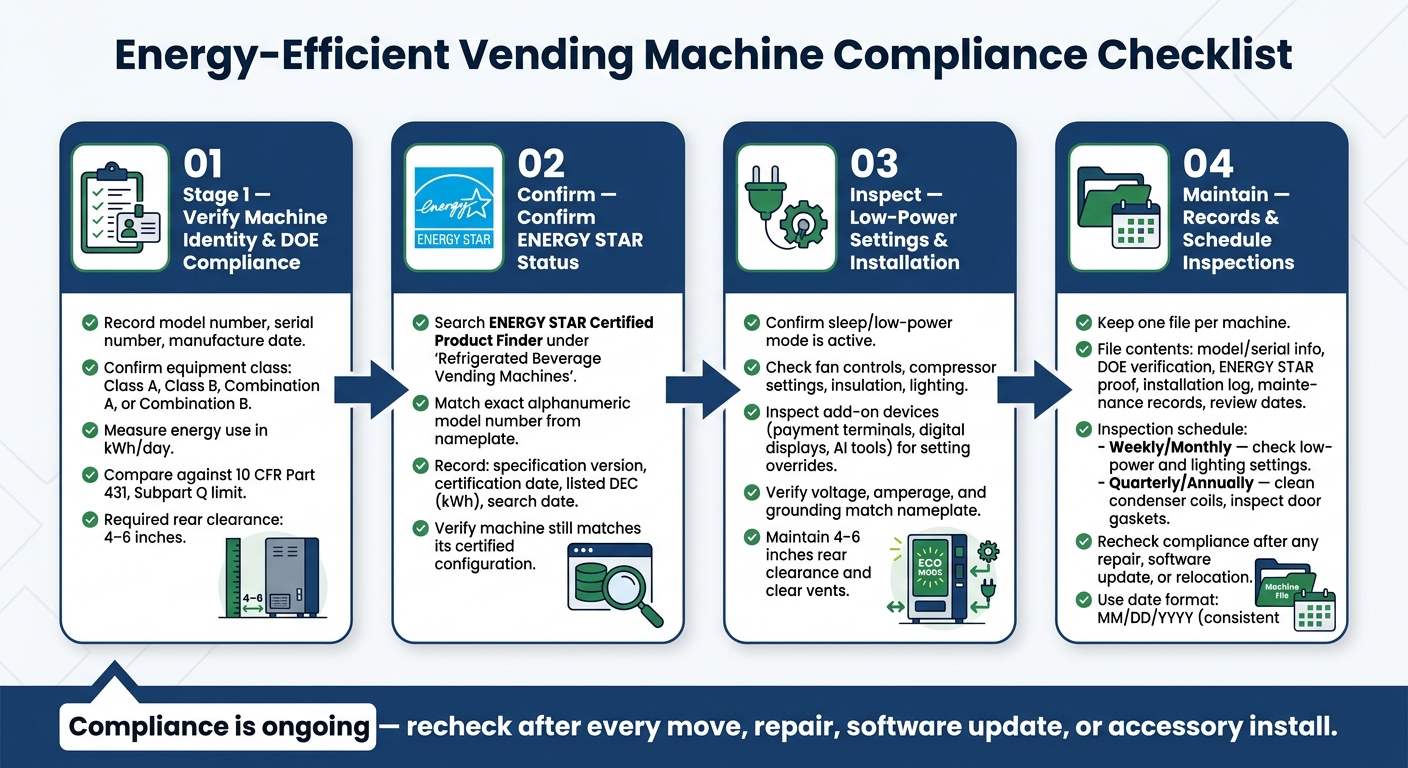
Energy-Efficient Vending Machine Compliance Checklist
Compliance with Energy Star Standards in Vending Machines
sbb-itb-aa27f9f
Checklist: Verify the Machine Meets the Applicable Energy Standard
Start with the nameplate. Record the model number, serial number, and date of manufacture. Once you know the exact machine you’re dealing with, compare it against the federal standard that applies to that specific unit.
Confirm Machine Identity and Equipment Class
Place the unit in the right equipment class: Class A, Class B, Combination A, or Combination B. That step matters because each class has its own federal energy limit. Then document the machine’s actual energy use in kWh/day using the applicable federal test method.
Use the records below to document the compliance review.
| Field | Details to Record |
|---|---|
| Manufacturer | Name as shown on the nameplate |
| Model Number | Exact model designation |
| Serial Number | Unique unit identifier |
| Date of Manufacture | As shown on the nameplate |
| Equipment Class | Class A, Class B, Combination A, or Combination B |
| Vendible Capacity | Record the machine’s vendible capacity |
| Measured kWh/day | kWh/day under the applicable test method |
| Status | Compliant, not compliant, or pending review |
| Notes | Missing data or discrepancies |
| Review Date | MM/DD/YYYY |
| Responsible Person | Name of the responsible person |
Check Federal and Nameplate Records
Next, compare the unit’s measured performance with 10 CFR Part 431, Subpart Q. Ask the manufacturer for the technical sheet and any official compliance documents for the specific model. Then confirm that the measured kWh/day is at or below the limit that applies.
Compliance Comparison Table
Use the table below to document the compliance review.
| Record or Source | What to Verify | Why It Matters |
|---|---|---|
| Nameplate | Manufacturer, model number, serial number, and date of manufacture | Identifies the unit and its production history |
| DOE requirements (10 CFR Part 431, Subpart Q) | Applicable energy conservation standard | Confirms the correct federal limit |
| Manufacturer technical sheet | Model specifications and energy data | Supports the compliance review |
| Official compliance documents | Compliance for the specific model | Verifies the unit matches the standard |
| Measured kWh/day | kWh/day under the applicable test method | Provides the performance data for comparison |
After the federal standard is confirmed, check ENERGY STAR status and operating features.
Checklist: Confirm ENERGY STAR Status and Energy-Saving Features
Once you’ve checked federal compliance, the next step is to confirm whether the machine also qualifies for ENERGY STAR and whether it’s still running the same way it was when it got certified.
Verify the Exact Model in the ENERGY STAR Database
Go to the ENERGY STAR Certified Product Finder and search under "Refrigerated Beverage Vending Machines." Then match the exact alphanumeric model number shown on the nameplate.
That detail matters. ENERGY STAR certification applies to specific configurations, not just a brand name or a product line.
As you check the listing, record:
- the specification version
- the certification date
- the listed DEC (kWh)
- the search date
After that, confirm the machine in the facility still matches the certified setup.
Inspect Low-Power Controls and High-Efficiency Components
Next, check that the machine still runs in its certified low-power state.
Make sure sleep mode or low-power mode is enabled and working as expected. Then review the main energy-saving parts and settings, including fan controls, compressor settings, insulation, and lighting.
Also look at any added systems, such as payment devices, digital displays, or AI inventory tools. Those upgrades can sometimes override low-power settings without anyone noticing.
Checklist: Installation, Operation, and Maintenance
Once you’ve confirmed the exact model and its certification status, the next step is simple: make sure the unit is installed, run, and serviced in a way that keeps it compliant.
Check Placement, Ventilation, and Electrical Setup
Leave the clearance required by the manufacturer on every side, including 4 to 6 inches behind the unit. Vents should stay clear of dust, debris, and anything nearby that could block airflow.
You’ll also want to confirm that the electrical connection matches the machine’s nameplate. Check the voltage, amperage, and grounding so the setup lines up with the stated requirements.
Set a Recurring Maintenance Inspection Schedule
A recurring inspection schedule helps catch small problems before they push energy use up.
Use the schedule below to keep the unit operating in its certified state:
- Weekly/Monthly: Confirm that low-power mode and lighting settings have not changed.
- Quarterly/Annually: Clean condenser coils thoroughly. Inspect door gaskets for cracks, compression loss, or air leaks. A worn gasket forces the refrigeration system to work harder to maintain temperature.
Recheck compliance after any refrigeration repair, software update, or relocation.
In fully managed programs like MotoSnax Vending, the provider handles maintenance and restocking. Even so, facility staff should still keep service records lined up with the inspection schedule.
Inspection Record Table
Keep a running log for every machine on-site. Use one consistent format for audits and internal reviews:
| Inspection Date | Machine ID | Location | Condition Checked | Energy-Saving Control Status | Corrective Action | Technician | Next Review Date |
|---|---|---|---|---|---|---|---|
| YYYY-MM-DD | VM-### | Location | Item inspected | Status | Action taken | Initials | YYYY-MM-DD |
Document Compliance and Action Summary
Records to Keep for Audits and Internal Reviews
Keep one file per machine. If you mix everything into fleet-wide logs, it gets hard to track a single unit’s history or confirm where it was installed.
The inspection log should be the main record in each machine file. For every machine on-site, keep these items together:
- Model number and serial information
- Original manufacturer instructions
- DOE verification records
- ENERGY STAR proof, where applicable
- Installation log – including placement and ventilation checks
- Maintenance records and corrective actions
- Scheduled review dates
Store the file in a format that’s easy to pull up fast. That could be a shared digital folder sorted by machine ID or a physical binder for each unit.
Applying This Checklist to Managed Vending Programs
If you run a managed fleet, add service records to that same per-machine file. With a provider like MotoSnax Vending, installation records and service logs can help back up compliance. For facility operators in New York and Connecticut, that provider data can help confirm that machine settings and placement still support energy-efficient operation.
That said, keep those records in your own per-machine file too. Don’t rely only on the provider’s system. Ask for copies and store them with your DOE and ENERGY STAR documents.
Conclusion: Key Compliance Points to Review Regularly
Choosing an energy-efficient machine is just the start. Compliance comes from keeping each unit certified, installed the right way, maintained, and documented.
When local rules change, machine settings are adjusted, or a unit is moved, treat that as a cue to run through this checklist again. For multi-site operators and building managers across New York and nearby U.S. markets, that habit is often the difference between being audit-ready and scrambling for paperwork when someone asks for it.
FAQs
How do I find my vending machine’s equipment class?
Your vending machine’s equipment class is usually listed in the machine paperwork or on the manufacturer’s ID label and model info.
If it’s not there, check your utility or energy program materials, or the compliance paperwork from the installation.
If you work with MotoSnax Vending, we can help identify the right class based on the machine model and its compliance details.
What changes can void ENERGY STAR status?
ENERGY STAR certification depends on the machine staying in its original certified setup. If someone makes unauthorized changes to internal parts, the refrigeration system, or the energy-management software, that certification can be voided.
Repairs done outside approved service channels, or the use of non-certified hardware, can also hurt energy efficiency ratings and put regulatory compliance at risk. MotoSnax Vending helps keep equipment compliant with professional maintenance and authorized updates.
When should I recheck vending compliance?
Recheck vending compliance any time your capacity needs go up, like when you switch from a smaller unit to a larger machine. Do the same when the equipment no longer matches your building’s brand or amenity standards.
It also makes sense to review compliance when you change payment tech, such as moving to a fully cashless system. MotoSnax Vending helps handle maintenance so equipment stays reliable and in line with compliance rules.